

Falco Fixed VOC Gas Detector is being used across the globe to monitor and detect hazardous gas leaks in the manufacturing process of electric vehicle (EV) batteries.
Introduction
Back in 2020, the UK Government took a huge step forward to achieve net-zero by announcing a ban of sales of new petrol and diesel cars by the 2030. This announcement has put the UK on course to be the fastest G7 country to decarbonise cars and vans. A 2 phase approach will be put in place to achieve this target. Step 1) Phase out the sale of new petrol and diesel cars and vans by 2030. Step 2) Every newly manufactured car and van to emit zero emissions from 2035. Between 2030 and 2035, the sale of new cars and vans will be permissible if they possess the capability to travel a considerable distance without emissions, such as plug-in hybrids or full hybrids. Source: www.gov.uk
With less petrol and diesel vehicles being manufactured, the world turns to the need for electric vehicles. There are multiple benefits of owning and using an electric vehicles, including:
- Reduced Emissions: Electric Vehicles produce zero emissions, meaning they don’t have a negative impact on air pollution and greenhouse gases.
- Lower Operating Costs: Eletricity is generally cheaper than gasoline or diesel, resulting in lower fuelling costs.
- Convenience: Many Electric Vehicle owners can charge their vehicle at home, meaning they can simply plug in their vehicle and charge it over night.
Lithium-ion batteries and the associated dangers
Electric vehicles are the short to medium term future of transportation, offering numerous advantages over traditional internal combustion engine vehicles, including reduced greenhouse gas emissions and improved air quality. However, the production of the lithium-ion batteries that power these vehicles comes with its own set of challenges, particularly in terms of safety.
High-capacity lithium-ion batteries, commonly found in electric vehicles, have the capability to recharge fully with minimal energy loss. They are typically composed of carbon or graphite, a metal oxide, and lithium salt, which constitute the positive and negative electrodes. These components are combined with electrolytes to facilitate the flow of electric current. At the end of their useful life, these batteries can be disassembled, allowing for the reuse of raw materials, with approximately 80 percent of the components being recyclable.
The primary components within lithium-ion batteries used in electric cars include the anode, cathode, separator, electrolyte, and lithium ions. EV battery cells typically contain approximately 17 pounds of lithium carbonate, 77 pounds of nickel, 44 pounds of manganese, and 30 pounds of cobalt. It is noteworthy that lithium is the most crucial component in EV batteries, and there is currently an unprecedented demand for this material.
Lithium-ion batteries are known for their high energy density and rechargeable nature, offer versatile applications but also pose risks that require attention. Potential hazards include thermal runaway, wherein the battery can overheat and even explode if damaged or exposed to high temperatures. Short circuits may lead to fires, and physical damage such as membrane punctures can cause internal harm. Overcharging, overheating, manufacturing defects, chemical reactions, aging, and external factors can also compromise battery safety.
The ION Science photoionisation detection (PID) sensors are able to detect potential problems before they occur in the manufacture and use of Li-ion batteries and the enormous variety of devices that use rechargeable batteries. With our ever-evolving digital age, the safe utilisation of Li-ion batteries is of paramount importance to manufacturers and customers. Click here to read the full ‘Li-ion battery risks reduced by VOC sensors’ blog.
Falco: The Cutting-Edge Fixed VOC Monitor
The Falco Fixed VOC Gas Detector continuously detects a wide range of volatile organic compounds (VOCs) and total aromatic compounds (TACs) using patented photoionisation detection (PID) technology. This fixed instrument plays a crucial role in ensuring the safety of works and the overall manufacturing process when producing lithium-ion (li-ion) batteries for electric vehicles (EVs). Falco is being used in multiple stages of the EV battery manufacturing process but is increasing being used to detect any leaks in individual cells. If a leak occurs, it could lead to a fire or even an explosion, therefore, it is essential that no leaks are present. The Falco Fixed VOC Gas Detector is used to detect the presence of any leaking gases at an early stage, reducing the changes of any life threatening accidents later down the line.
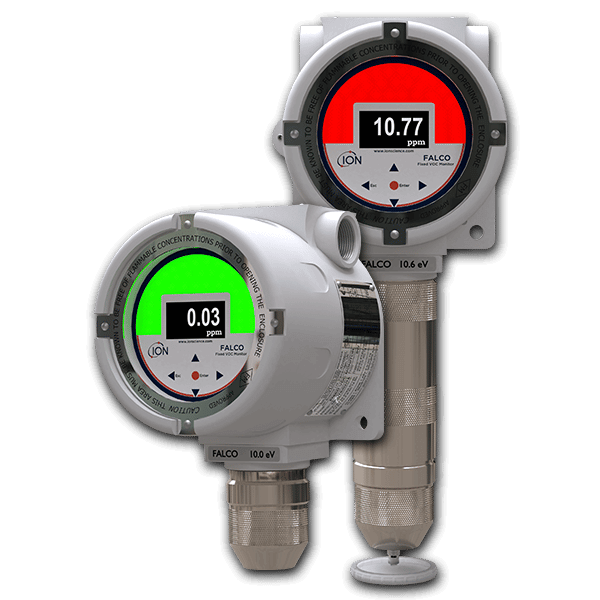
Key Features of Falco include:
High Sensitivity
Falco boasts a high sensitivity to a wide range of VOCs, ensuring that leaks are detected promptly.
Continuous Monitoring
It provides real-time, continuous monitoring, allowing for immediate response to any abnormal levels of VOCs.
Customisable Alarms
Falco allows for customisable alarm settings, alerting facility personnel when VOC concentrations exceed safe levels.
User-Friendly Interface
The user-friendly interface makes it easy for operators to set up and use the device efficiently.
Low Maintenance
Falco requires minimal maintenance, reducing operational costs and downtime.
Multiple Output Options
Falco has 2 programmable relays, 3 – 20 mA output and RS485 MODBUS.
Certified
Falco is ATEX, IECEx and QPS certified.

Protecting Lives and Preserving the Environment
The implementation of Falco fixed VOC monitors in EV battery manufacturing facilities is not just about compliance with safety regulations; it’s also about ensuring a sustainable future. These monitors help in preventing VOC emissions into the atmosphere, which can have long-term adverse effects on air quality and climate change. By promptly detecting and addressing leaks, EV battery manufacturers contribute to a greener and more sustainable world.
At the heart of ION Science’s business vision lies a simple yet powerful mission:
…..
“To protect lives and preserve the environment”.
This encapsulates their unwavering commitment to creating products and solutions that enhance safety while minimising environmental impact. For years, ION Science has been at the forefront of the industry, offering accurate and reliable technology that detects harmful gases and volatile organic compounds (VOCs), making workplaces safer and ensuring a healthier planet.
Conclusion
As the electric vehicle revolution accelerates, the importance of safe and sustainable battery manufacturing cannot be overstated. Falco, the cutting-edge fixed VOC monitor, stands as a beacon for the industry. With its highly sensitivity, real-time monitoring, and remote access capabilities, it is revolutionising how EV battery manufacturing facilities protecting their workforce and the environment.
By choosing Falco, these facilities are not only complying with safety regulations but also actively contributing to a cleaner and healthier planet. As the EV industry continues to grow, Falco will continue to play an indispensable role in safeguarding both the workforce and our shared future.
Contact us today
To discuss with the instrumentation team how Falco can be used in your application.

Due to advanced PID Sensor technology, safety hazards associated with Li-ion battery storing and usage can be mitigated, allowing safety measures to be implemented.
Sensitive photoionisation detection (PID) sensors are able to detect potential problems before they occur in the manufacture and use of Li-ion batteries and the enormous variety of devices that use rechargeable batteries. With our ever-evolving digital age, the safe utilisation of Li-ion batteries is of paramount importance to manufacturers and customers.
The risks posed by Li-ion batteries have been highlighted by a number of high-profile incidents hitting mainstream media. Famously, in 2016, around 2.5 million mobile phones were recalled after complaints of overheating and exploding batteries. Extensive investigations revealed insufficient insulation material within the batteries and a design that did not provide sufficient space to safely accommodate the batteries’ electrodes were the main catalysts for these incidents. As a result of the magnitude of this problem, and the global publicity which ensued, demand grew for sensing technology that can detect faulty Li-ion batteries, both during production and operation.
The main safety concern associated with failing Li-ion batteries is the ignition of the battery cell. Not only does this pose an immediate acute (short-term) hazard to individuals, but over long periods of time can cause the emission of toxic gases. These gases include volatile organic compounds (VOCs), meaning sensitive VOC sensors can be used to check the condition of these batteries – either within portable detectors or in process/plant monitoring equipment.
The anode in rechargeable Li-ion batteries is typically graphite, the cathode is a metal oxide, and the electrolyte is usually a lithium salt in a (flammable) organic solvent. This electrolyte includes compounds such as ethyl methyl carbonate (EMC) which is known to be among the gases emitted by a faulty Li-ion battery. Conveniently, EMC can be detected by ION Science’s PID, so the developers of monitoring systems and equipment are able to design technologies that utilise ION’s MiniPID sensors.
The RFs for VOCs commonly used in Li-ion battery electrolytes are presented in Table 1: Evaluation of chemicals used in lithium-ion batteries.
|
VOC |
Boiling Point oC |
RF |
Sat. vapour pressure @ 25 oC bar |
Prospective maximum response, ppm (IBE) |
Measured spike response, ppm (IBE) |
|
Dimethyl carbonate |
91 |
65 |
0.07 |
1000 |
80 |
|
Ethyl methyl carbonate |
107 |
18 |
0.035 |
2000 |
240 |
|
Diethyl carbonate |
127 |
7.5 |
0.015 |
2000 |
390 |
|
Vinylene carbonate |
162 |
3.5 |
0.0033 |
1000 |
480 |
|
Butylene carbonate 1,2- |
238 |
18 |
0.0002 |
1 |
10 |
|
Propylene carbonate |
242 |
15 |
0.0002 |
1 |
80 |
|
Ethylene carbonate |
243 |
>50 |
0.0003 |
0.5 |
<1 |

Due to their specificity, PID sensors are the most commonly employed technology for the detection of VOCs, and ION’s MiniPID range includes the most sensitive PID sensor in the world, which makes it ideal for the detection of trace leaks from faulty Li-ion batteries.
Summarising, Peter Morris from ION Science says:
“Prospective customers for our PID sensors in Li-ion battery applications include the developers of portable instruments, as well as the designers of monitoring systems for processes within battery manufacturing, as well as in the manufacture of EVs, e-bikes, laptops, tablets, phones and many others.”

Contact us today
To discuss with the sensing team how we’re reducing risks and protecting lives in the electric vehicle, e-bike, and electronics industries and how we can support you:

What is a Part Per Million (PPM)?
Measuring Acetone to Hydrogen sulphide, Benzene to Xylene, if you are measuring harmful gases, you are likely to measure them using PPM units. Parts Per Million is self-explanatory, it’s simply the number of gas molecules in a million but what does PPM look like?
This simple video offers a clear graphical representation of Part Per Million followed by Part Per Billion!
YouTube video playerNeed to know more about harmful gases?
Gas fact sheets are available to download for many harmful gases. They not only contain background information like the chemical’s history, they include where the gas is used and harmful effects.

As leaders in gas analysis and detection of volatile organic compounds, ION Science are at the forefront of the latest news and developments. Terminology in the field is often changing or alters between countries and legislative bodies. No definition is more important to the industry than that of the VOC.
Typically, we understand the term VOC to mean volatile organic compound. This refers to any organic compound that can be found as a gas in the atmosphere. However, not all VOCs are harmful or dangerous. Some can be in certain concentrations or environments, but regardless of the risk, monitoring them is essential to manage exposure. Particularly for the industries that ION Science supports, having essential gas detection and analysis capabilities is critical, therefore having universally understood terminology is essential.
VOC is a term that can be applied to any volatile organic compound, generally it is more commonly used for health and safety and indoor air quality. Although, the general term used for outdoor air quality is non methane volatile organic compound, or NMVOC.
The reason for specifying whether the VOC is methane or non-methane has become more important in recent years, as the rules around how certain VOCs and other gases are monitored has shifted.

Definition of an NMVOC
The technical definition of an NMVOC, as given in the official guidelines from the European Monitoring and Evaluation Programme (EMEP) is as follows:
“NMVOCs comprise all organic compounds except methane which at 293.15 K show a vapour pressure of at least 0.01 kPa (i.e. 10 Pa) or which show a comparable volatility under the given application conditions”
The Air Quality Expert Group (AQEG) define NMVOCs as:
“…a broad class of organic chemicals that are, in a small number of cases, directly harmful to health, but that more generally act as precursors to the formation of ozone and particulate matter (PM).”
The volatility of a compound is generally higher the lower its boiling point temperature, the volatility of organic compounds is therefore sometimes defined and classified by boiling points. Importantly this definition can differ by geography, for example, the European Union uses the boiling point, rather than its volatility in its definition.
Why is methane excluded?
Methane is a common emission resulting from many activities, such as road transport, manufacturing, and agriculture. However, methane is excluded from VOC monitoring in many cases, as it is relatively non-toxic and poses little harm to human health (although it does pose notable environmental concerns). By excluding methane from VOC analysis and detection by isolating non-methane volatile organic compounds, it is easier to understand the impact of NMVOCs on human health.
Methane is also typically present in high concentrations in atmospheric conditions. Although, PID instrumentation doesn’t detect methane, and environmental concentrations of methane don’t adversely affect PID readings. Methane concentrations are at 2ppm, whereas NMVOCs are much lower than this. Therefore, if the instrumentation detected Methane, it would mask the other elements. This is one of the reasons why PIDs are effective at measuring/detecting outdoor VOCs. When you are aiming to detect potentially trace amounts (parts per million or billion) of highly potent VOCs, being able to have analysis and detection that is not impacted by more common compounds is vital for accuracy and appropriate levels of safety and protection.
ION Science develop, manufacture, and supply gas detection instruments that can detect a range of VOCs and NMVOCs, depending on the requirements of the customer. To keep staff and the public safe in all environments, ION Science gas detection offers unrivalled capabilities and unbeatable accuracy. Discover more about the portable, personal, and fixed instruments today, or explore the range of industry leading PID sensors.
For press enquiries please contact: Hannah Albone hannah.albone@cogent.co.uk or 07483047567, alternatively contact David Leatham David.leatham@cogent.co.uk or on 07483 071 833.

ION Science on target to achieve £20 million turnover in its 30th anniversary year
Increasing awareness of the need to monitor volatile organic compounds for indoor and outdoor air quality drives demand for photoionisation detectors
Ion Science announced its target of £20 million in 2019 on its 30th anniversary, this is in line with its year-on-year growth of 30%.
Increasing global awareness of the need to monitor volatile organic compounds (VOCs) for indoor and outdoor air quality continues to drive demand. Ion Science is delighted to meet this demand with its high-performance photoionisation (PID) VOC gas detectors.
Further underlining its position as the world’s largest manufacturer of VOC monitors, Ion Science now has global subsidiary offices. It now has offices in France, Italy, Germany, India, China and the USA with a fast-growing distributor network.
A record month was recorded in April 2019 with an unprecedented £1.3 million turnover. This was largely due to an order for 180 of its popular Tiger handheld instruments. The company has also benefitted from sales growth across Scandinavia and the Far East.
Company growth
Duncan Johns the managing Director of Ion Science says; “There is no doubt that widening recognition of the damaging effects of VOCs on health and the environment continues to fuel our growth. Companies are seeking well-designed, robust and reliable gas detection instruments to protect employees and the wider community.”
“As a technology-led business, it is imperative we continue to move forward and push boundaries. This is demonstrated by considerable investment in strategically located subsidiary offices in Europe and the Rest-of-the-World. Another major factor is the expansion of our MiniPID sensor range, with a focus on indoor air quality applications.”
“Despite being established for 30 years, we are proud that our philosophies, core values and vision are the same as ever. We are committed to developing market-leading, cost-effective and efficient sensing devices for end-users across the world.”
Ion Science was responsible for developing the world’s first truly field worthy and accurate PID detector patented in 1998. In 2000, it launched the PhoCheck 5000EX which was its first PID instrument designed to detect VOCs down to ppb levels. Our range of Hydrosteel corrosion monitors also continues to be the world’s premium hydrogen flux monitors used in petrochemical streams.
A global advantage
A fundamental advantage of Ion Science’s PID is the globally patented Fence electrode technology. This enables VOC measurements in contaminated, hot and humid atmospheres.
The serviceability and robustness of the PID using the Fence Electrode were enhanced by the in-house manufacture of a miniaturised PID. These MiniPID sensors are also used in the Tiger instrument series and other PID instruments.
The company has also dedicated considerable resources into selective benzene measurements. The Tiger Select, Cub TAC, Titan and Falco TAC offer a complete range of benzene products for the petrochemical industries.
Another key milestone for Ion Science was the move into a new state-of-the-art building in autumn 2017. This £4.5 million, 1500m2 facility is located in the village of Fowlmere in Cambridgeshire and is the head office. The building was designed to meet current and short-term needs, as well as reflect the on-going ambitions of the business.
To learn more about ION Science, contact us on E: info@ionscience.com or T: +44 (0) 1763 208 503.