

ION Science has successfully secured a contract to supply 4000 ARA H2S units within the Onshore and Offshore Oil, Gas and Petrochemical Industry.
ION Science is thrilled to announce that we have been awarded a significant contract to supply 4000 ARA H2S units to a valued customer in the United Arab Emirates (UAE).
Securing this contract was highly competitive, with the two key deciding factors being:
- Price
- Fast Delivery
Pricing is always a critical factor in the decision-making process, however, a key differentiator was our proven capability to meet the customers urgent delivery requirements. Additionally, we committed to completing the first shipment of ARA units to the customer within a remarkably short timeframe. ION Science’s continued ability to deliver competitive pricing and rapid delivery is driving the popularity of the full ARA range.
ION Science delivers customers a dependable supply chain, efficient production processes, and a dedicated global network there to meet customer need promptly and reliably.
Our success in securing this contract highlights the trust and confidence our customers place in ION Science, and we are proud to support their operations with our H2S and single gas detection technology.
We look forward to building on this success and continuing to provide exceptional service and innovative solutions to our customers worldwide.
ION Science’s ARA Range
ARA is a personal, disposable, single gas detector for H2S, CO, SO2, and O2 that provides instantaneous alarms for life-critical safety scenarios.
ION Science’s ARA single gas detectors are safety compliance devices for daily use across various industries, including oil & gas, chemical, manufacturing, and more. They ensure safety in applications like site-wide monitoring, confined space entry, plant shutdowns, and emergency response by alerting users to unsafe gas levels, thus enhancing worker safety and efficiency.
Learn more about our ARA range here.

Ready for unbeatable prices and fast delivery? Contact us today!
Have a question or enquiry relating to ARA? Complete the form below to be connected with your local ION Science representative!

ION Science have created a chart detailing over 1000 PID response factors (RFs) that use either a 10.0 eV, 10.6 eV and 11.7 eV lamp.
This downloadable response factor chart serves as a comprehensive reference, providing you with essential gas information including gas names, formulas, CAS numbers, ionisation energies, and recommended lamp variants.
It addresses the needs of researchers and industry professionals by offering swift access to information on specific gases that PID can detect. Plus, the inclusion of detailed chemical formulas proves advantageous for individuals engaged in a spectrum of chemical processes.
The chart includes RFs for important chemicals, listed by their common names, but CAS numbers are recommended for precise identification. RFs are guideline figures, subject to variation based on PID design and operating conditions. ION Science advises calibrating the instrument to the target gas at the desired measurement concentration for accuracy.
Users should exercise caution in measuring PID responses at high or low concentrations, considering non-linearity, sensor clear-down time, and potential contamination of the PID window. Frequent calibration or bump tests are recommended, especially for less common volatiles. RFs labeled as ‘ZR’ indicate zero response, and ‘NA’ signifies an unavailable or insignificant value at toxic concentrations.
The RFs of many chemicals have been measured at ION Science typically with 10 and 50 ppm of the target volatile, using ten PIDs containing lamps of different photon energy and intensity and of different sensor designs. Generally, 50 ppm responses have been used. These RFs are indicated in bold in the chart.
Complete the form below to receive your copy of the PID Response Factor Chart.
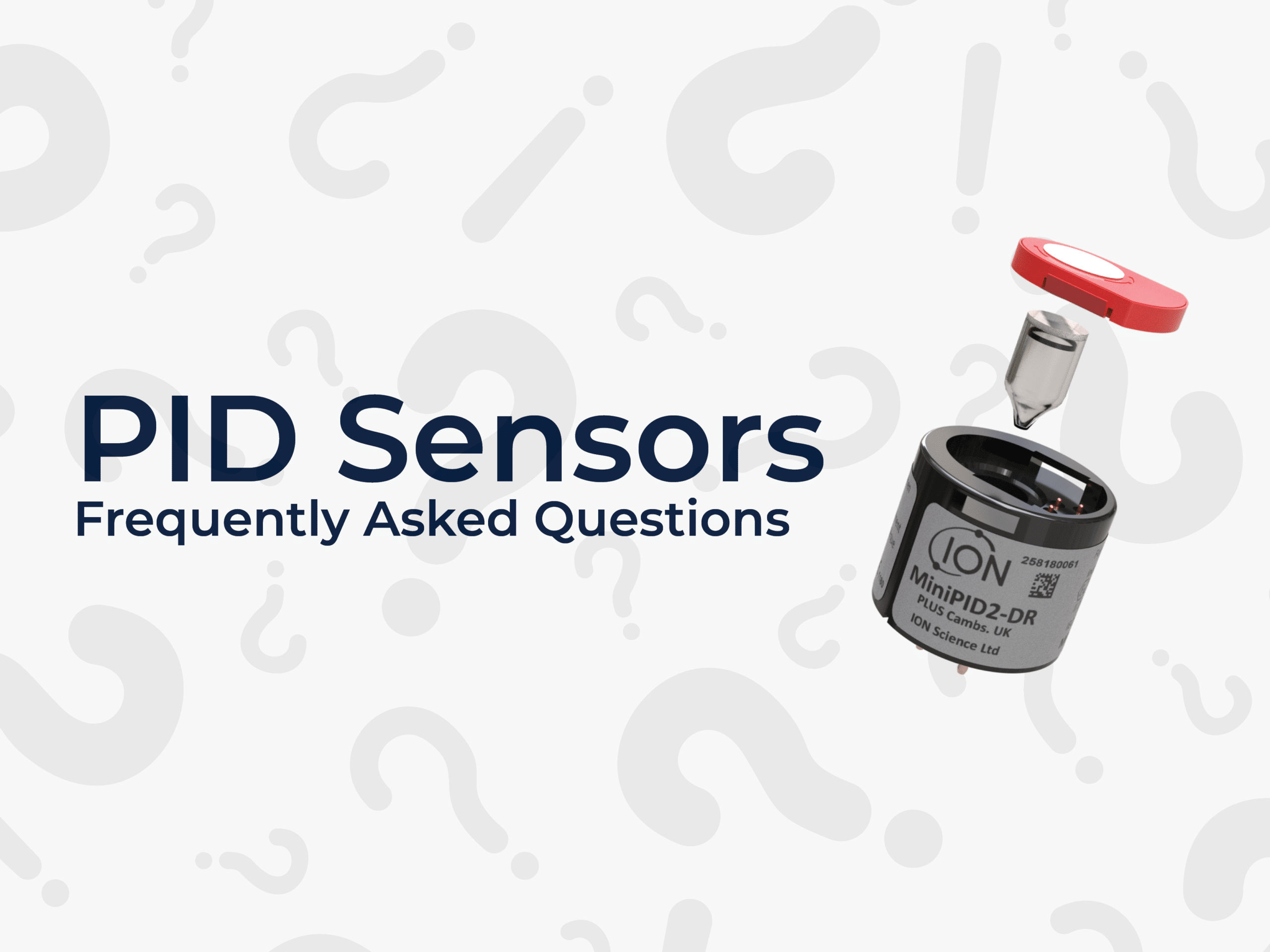
Everything you need to know about PID Sensors
PID stands for “Photo-Ionisation Detector”. PID (Photoionisation Detection) sensors are essential tools for monitoring air quality and can be incorporated into a hand-held, personal, or fixed detector for the detection of volatile organic compounds (VOCs) and some inorganic compounds.
ION Science sensors can detect VOCs down to parts-per-billion (ppb) and up to thousands of parts-per-million (ppm). In this article ‘Everything you need to know about PID Sensors’, we’ll answer some frequently asked questions about PID sensors to help you better understand their applications, advantages, and importance across various industries.
-
What is a PID Sensor?
A PID sensor is a device used to measure and monitor volatile organic compounds (VOCs) to very low concentrations and other gases in the air. It relies on a process called photoionisation to detect and quantify these substances.
-
How Does a PID Sensor Work?
A PID sensor works by irradiating a gas sample with ultraviolet light. This light energy ionizes the gas molecules, producing positively charged ions and an electron. The resulting ionization current from the electrons is proportional to the concentration of the VOCs in the sample.
-
Where Are PID Sensors Used?
PID sensors are used in a variety of industries, including environmental monitoring, industrial safety, hazardous material response, indoor air quality assessments and ambient outdoor air quality.
-
What Are the Key Advantages of PID Sensors?
PID sensors offer fast and accurate measurements, real-time monitoring, and the ability to detect a wide range of VOCs. They are also portable and easy to use, making them versatile tools for many applications.
-
What Types of VOCs Can PID Sensors Detect?
PID sensors can detect a broad spectrum of VOCs, including solvents, fuels, pesticides, and other organic compounds.
-
Are PID Sensors Safe to Use?
Yes, PID sensors are safe to use when operated according to manufacturer instructions. They are designed to be non-destructive and non-invasive.
-
How to Calibrate a PID Sensor?
Calibrating a PID sensor involves exposing it to a known concentration of a specific VOC and recording the mV response for that known concentration. This is often done at the zero point, at the midpoint and at the end of the detection range. . Regular calibration ensures accurate readings.
-
What Factors Can Affect PID Sensor Accuracy?
Environmental conditions, sensor contamination, and the presence of interfering compounds can affect some PID sensor accuracy on the market. ION Science’s innovative feature of humidity-resistance helps maintain optimum sensor performance in challenging humidity conditions, contributing to reliable and accurate readings in diverse environments.
-
Can PID Sensors Detect Gas Concentrations in Real-Time?
Yes, PID sensors provide real-time measurements, allowing for immediate response to changing gas concentrations.
-
How to Choose the Right PID Sensor for Your Application?
Consider factors like the range of VOCs you need to detect, required sensitivity, environmental conditions, and the intended application when choosing a PID sensor.
-
What Are the Maintenance Requirements for PID Sensors?
Regular maintenance, including cleaning, calibration, and sensor replacement, is crucial to ensure PID sensors operate optimally.
-
Are PID Sensors Compatible with Data Logging and Remote Monitoring Systems?
Yes, many PID sensors can be integrated into data logging and remote monitoring systems for enhanced data collection and analysis.
-
What Should You Consider When Handling and Storing PID Sensors?
Proper storage and handling are essential to prevent damage to PID sensors. This includes protecting them from extreme temperatures and physical damage.
-
How Do PID Sensors Compare to Other Gas Detection Technologies?
PID sensors excel in detecting VOCs but may not be suitable for all gas types. Compare them to other gas detection technologies to determine the best choice for your needs.
-
Can PID Sensors Detect Combustible Gases?
While PID sensors are primarily designed for VOC detection, some models can detect combustible gases indirectly by measuring changes in VOC concentration.
-
What Are the Future Developments in PID Sensor Technology?
Future developments may focus on improved sensitivity, lower detection limits, and enhanced data integration capabilities.
For more information on MiniPID 2, watch the video here.
Conclusion
PID sensors are valuable tools for detecting and quantifying VOCs in various applications. Understanding their operation, maintenance, and suitability for different industries is crucial for their effective use. As technology advances, PID sensors continue to play a significant role in ensuring air quality and safety.
This ‘Everything you need to know about PID Sensors’ article provides a comprehensive overview of PID sensors, helping you make informed decisions when considering this technology for your specific application.
Do you have a question for the ION Science Sensor Team?
Ask the question below!

Due to advanced PID Sensor technology, safety hazards associated with Li-ion battery storing and usage can be mitigated, allowing safety measures to be implemented.
Sensitive photoionisation detection (PID) sensors are able to detect potential problems before they occur in the manufacture and use of Li-ion batteries and the enormous variety of devices that use rechargeable batteries. With our ever-evolving digital age, the safe utilisation of Li-ion batteries is of paramount importance to manufacturers and customers.
The risks posed by Li-ion batteries have been highlighted by a number of high-profile incidents hitting mainstream media. Famously, in 2016, around 2.5 million mobile phones were recalled after complaints of overheating and exploding batteries. Extensive investigations revealed insufficient insulation material within the batteries and a design that did not provide sufficient space to safely accommodate the batteries’ electrodes were the main catalysts for these incidents. As a result of the magnitude of this problem, and the global publicity which ensued, demand grew for sensing technology that can detect faulty Li-ion batteries, both during production and operation.
The main safety concern associated with failing Li-ion batteries is the ignition of the battery cell. Not only does this pose an immediate acute (short-term) hazard to individuals, but over long periods of time can cause the emission of toxic gases. These gases include volatile organic compounds (VOCs), meaning sensitive VOC sensors can be used to check the condition of these batteries – either within portable detectors or in process/plant monitoring equipment.
The anode in rechargeable Li-ion batteries is typically graphite, the cathode is a metal oxide, and the electrolyte is usually a lithium salt in a (flammable) organic solvent. This electrolyte includes compounds such as ethyl methyl carbonate (EMC) which is known to be among the gases emitted by a faulty Li-ion battery. Conveniently, EMC can be detected by ION Science’s PID, so the developers of monitoring systems and equipment are able to design technologies that utilise ION’s MiniPID sensors.
The RFs for VOCs commonly used in Li-ion battery electrolytes are presented in Table 1: Evaluation of chemicals used in lithium-ion batteries.
|
VOC |
Boiling Point oC |
RF |
Sat. vapour pressure @ 25 oC bar |
Prospective maximum response, ppm (IBE) |
Measured spike response, ppm (IBE) |
|
Dimethyl carbonate |
91 |
65 |
0.07 |
1000 |
80 |
|
Ethyl methyl carbonate |
107 |
18 |
0.035 |
2000 |
240 |
|
Diethyl carbonate |
127 |
7.5 |
0.015 |
2000 |
390 |
|
Vinylene carbonate |
162 |
3.5 |
0.0033 |
1000 |
480 |
|
Butylene carbonate 1,2- |
238 |
18 |
0.0002 |
1 |
10 |
|
Propylene carbonate |
242 |
15 |
0.0002 |
1 |
80 |
|
Ethylene carbonate |
243 |
>50 |
0.0003 |
0.5 |
<1 |

Due to their specificity, PID sensors are the most commonly employed technology for the detection of VOCs, and ION’s MiniPID range includes the most sensitive PID sensor in the world, which makes it ideal for the detection of trace leaks from faulty Li-ion batteries.
Summarising, Peter Morris from ION Science says:
“Prospective customers for our PID sensors in Li-ion battery applications include the developers of portable instruments, as well as the designers of monitoring systems for processes within battery manufacturing, as well as in the manufacture of EVs, e-bikes, laptops, tablets, phones and many others.”

Contact us today
To discuss with the sensing team how we’re reducing risks and protecting lives in the electric vehicle, e-bike, and electronics industries and how we can support you:

ION Science wins Queen’s Award for Enterprise: Innovation for MiniPID Sensors
ION Science is delighted to announce it has won the prestigious Queen’s Award for Enterprise in the category of Innovation, for its pioneering MiniPID sensors. The award is the highest recognition of business excellence across Britain and endorses the commercial success in respect to the innovative technology. ION Science’s industry-leading PID (photoionisation detection) technology, offers unparalleled VOC detection.
The achievement of the Queen’s Award for Innovation reaffirms the quality, reliability and success of the MiniPID sensor. And just how dedicated ION Science is to developing and producing new technologies. Prior to the development of the MiniPID sensor range, VOC sensors often suffered from short operational life, unreliable technology, and failed in the face of challenging environmental conditions.
The MiniPID sensor addresses all these issues and more, highlighting why it is the market leader in quality and standards for all VOC sensors. Able to withstand relative humidity up to 99% (non-condensing), temperatures of -40 to +65 °C, and with an anti-contamination design, the MiniPID range offers 10,000 hours of reliable detection, ideal for long-term monitoring. Sensitivity for VOC measurement can be conducted in ppm (parts per million) or ppb (parts per billion), over a wide range or across a small area. ION Science’s sensors can be used to detect up to 950 different compounds, many of which pose a serious threat to human health and life if people are exposed.
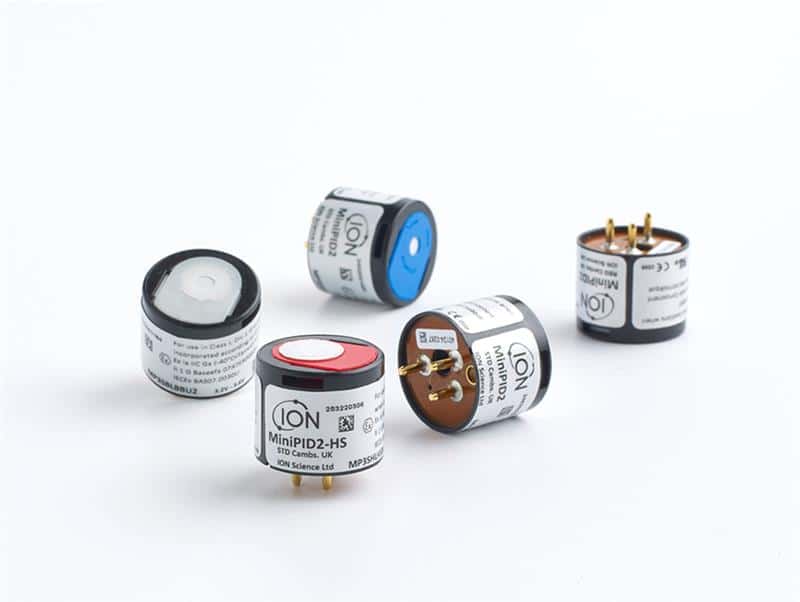
Duncan Johns, Managing Director of ION Science, said of the win: “It’s wonderful to see the hard work of all the staff here at ION Science recognised with the success of the Queen’s Award. As an organisation we are always striving to achieve the next level of innovation in technology, which is exactly represented by the MiniPID sensor range. We’re looking forward to the future of ION Science and the next steps with our award-winning sensors.”
Dr Peter Morris, head of the Sensors Product Business Unit at ION Science, also spoke of the MiniPID: “Achieving this outstanding level of recognition for the MiniPID sensor is a fantastic result for the Sensors team. Many of us have worked at ION Science for decades and seen the development of the MiniPID since its inception in 2007. Being able to have the affirmation of the MiniPID sensor as an ‘Innovation’ by the Queen’s Award for Enterprise is a great highlight and we’re very proud to receive it.”
Across the globe today, MiniPID sensors can be found in many applications, including oil rigs, gas refineries, pharmaceutical manufacturing plants, semiconductor factories, laboratories, nuclear facilities, air quality monitoring and more, protecting the health and safety of workers, public and the environment.
MiniPID sensors represent a monumental step forward in protecting staff, but also in ensuring product quality and keeping workplaces as healthy as possible. The advanced VOC detection capabilities mean that no matter what application, environment, or compounds, MiniPID sensors exceed the customer need and delivers high quality, reliable results.

ION Science’s range of MiniPID sensors are now available to buy directly from the award winning manufacturer – contact them today to find out more: https://ionscience.com/en/sensors-and-components/oem-sensors/
For press enquiries please contact: Hannah Albone hannah.albone@cogent.co.uk or 07483047567, alternatively contact David Leatham David.leatham@cogent.co.uk or 07483 071 833.
To find out more about ION Science and our award winning innovative MiniPID technology!
Please complete the form below and a member of our team will contact you shortly.

What is a Part Per Million (PPM)?
Measuring Acetone to Hydrogen sulphide, Benzene to Xylene, if you are measuring harmful gases, you are likely to measure them using PPM units. Parts Per Million is self-explanatory, it’s simply the number of gas molecules in a million but what does PPM look like?
This simple video offers a clear graphical representation of Part Per Million followed by Part Per Billion!
YouTube video playerNeed to know more about harmful gases?
Gas fact sheets are available to download for many harmful gases. They not only contain background information like the chemical’s history, they include where the gas is used and harmful effects.

As leaders in gas analysis and detection of volatile organic compounds, ION Science are at the forefront of the latest news and developments. Terminology in the field is often changing or alters between countries and legislative bodies. No definition is more important to the industry than that of the VOC.
Typically, we understand the term VOC to mean volatile organic compound. This refers to any organic compound that can be found as a gas in the atmosphere. However, not all VOCs are harmful or dangerous. Some can be in certain concentrations or environments, but regardless of the risk, monitoring them is essential to manage exposure. Particularly for the industries that ION Science supports, having essential gas detection and analysis capabilities is critical, therefore having universally understood terminology is essential.
VOC is a term that can be applied to any volatile organic compound, generally it is more commonly used for health and safety and indoor air quality. Although, the general term used for outdoor air quality is non methane volatile organic compound, or NMVOC.
The reason for specifying whether the VOC is methane or non-methane has become more important in recent years, as the rules around how certain VOCs and other gases are monitored has shifted.

Definition of an NMVOC
The technical definition of an NMVOC, as given in the official guidelines from the European Monitoring and Evaluation Programme (EMEP) is as follows:
“NMVOCs comprise all organic compounds except methane which at 293.15 K show a vapour pressure of at least 0.01 kPa (i.e. 10 Pa) or which show a comparable volatility under the given application conditions”
The Air Quality Expert Group (AQEG) define NMVOCs as:
“…a broad class of organic chemicals that are, in a small number of cases, directly harmful to health, but that more generally act as precursors to the formation of ozone and particulate matter (PM).”
The volatility of a compound is generally higher the lower its boiling point temperature, the volatility of organic compounds is therefore sometimes defined and classified by boiling points. Importantly this definition can differ by geography, for example, the European Union uses the boiling point, rather than its volatility in its definition.
Why is methane excluded?
Methane is a common emission resulting from many activities, such as road transport, manufacturing, and agriculture. However, methane is excluded from VOC monitoring in many cases, as it is relatively non-toxic and poses little harm to human health (although it does pose notable environmental concerns). By excluding methane from VOC analysis and detection by isolating non-methane volatile organic compounds, it is easier to understand the impact of NMVOCs on human health.
Methane is also typically present in high concentrations in atmospheric conditions. Although, PID instrumentation doesn’t detect methane, and environmental concentrations of methane don’t adversely affect PID readings. Methane concentrations are at 2ppm, whereas NMVOCs are much lower than this. Therefore, if the instrumentation detected Methane, it would mask the other elements. This is one of the reasons why PIDs are effective at measuring/detecting outdoor VOCs. When you are aiming to detect potentially trace amounts (parts per million or billion) of highly potent VOCs, being able to have analysis and detection that is not impacted by more common compounds is vital for accuracy and appropriate levels of safety and protection.
ION Science develop, manufacture, and supply gas detection instruments that can detect a range of VOCs and NMVOCs, depending on the requirements of the customer. To keep staff and the public safe in all environments, ION Science gas detection offers unrivalled capabilities and unbeatable accuracy. Discover more about the portable, personal, and fixed instruments today, or explore the range of industry leading PID sensors.
For press enquiries please contact: Hannah Albone hannah.albone@cogent.co.uk or 07483047567, alternatively contact David Leatham David.leatham@cogent.co.uk or on 07483 071 833.

The photoionisation detector (PID) has proven to be an ideal solution to monitor benzene within the environment. But there are several considerations that must be borne in mind when choosing an instrument.
PID theory of operation
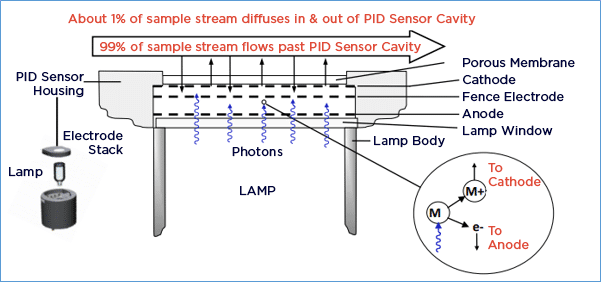
Figure 1 is a schematic of a typical PID sensor system. A UV lamp generates high- energy photons, which pass through the lamp window and a mesh electrode into the sensor chamber. Sample gas is pumped over the sensor and about 1% of it passes through a porous membrane into the other side of the sensor chamber. The inset on the ‘lower right’ of figure 1 shows what happens on a molecular level. When a photon with enough energy strikes a molecule M, an electron (e-) is ejected. M+ ion travels to the cathode and the electron travels to the anode, resulting in a current proportional to the gas concentration. The electrical current is amplified and displayed as a ppm (or part per billion (ppb)) concentration. Not all molecules can be ionized, thus, the major components of clean air, i.e., nitrogen, oxygen, carbon dioxide, argon, etc., do not cause a response, but most VOCs do give a response.
Which lamp do I need?
Typically, three lamps are available with maximum photon energies, measured in electron- volts (eV), of 10.0 eV, 10.6 eV, and 11.7 eV. Figure 2 illustrates that a lamp can only detect those compounds with ionization energies (IE) equal to or below that of the lamp. Thus, a 10.6 eV lamp can measure Methyl Bromide with an IE of 10.5 eV and all compounds with a lower IE, but cannot detect methanol or compounds with a higher IE.
The choice of lamp therefore depends on the application. When only one compound is present, one can use any lamp with enough energy, often the standard 10.6 eV lamp which has a lower cost point and has a long working life of up to a few years. Conversely the 11.7 eV lamp has a short life of only a few months.
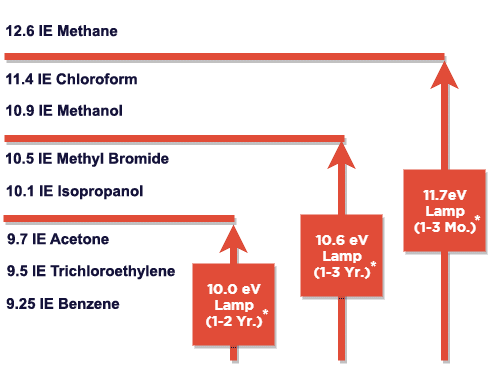
Benzene has a low IE value as shown in Figure 2 and it is often present in a ‘cocktail’ of other chemicals including aromatics and aliphatic. Using a proprietary 10.0 eV lamp means that only the aromatics are detected (amongst other gasses that may be present) and should the total aromatic compounds (TACs) be above the regulatory limit, a benzene pre- filter tube can be used to provide a more accurate reading to monitor benzene.
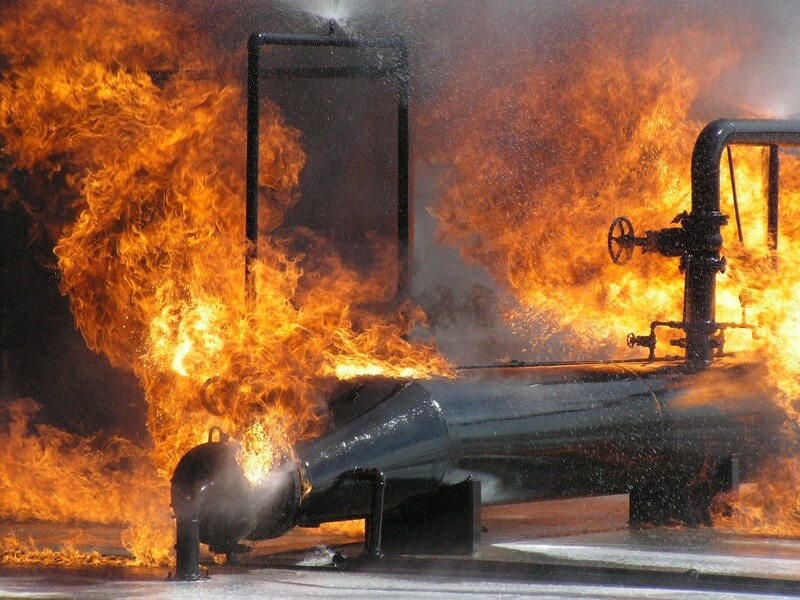
PID for Arson Investigation
One such tool for the detection of accelerants at fire scenes recommended by investigators3 is the photoionisation detector (PID) which has already proven to be an ideal solution for the detection of relatively low level VOCs for health & safety and environmental applications.
These devices are battery powered and portable and can be deployed rapidly and safely to test areas between floorboards and under carpets where residual traces of accelerant may remain.
Where positive indications of accelerant residue are discovered, grab samples can be taken and carefully stored for subsequent analysis using headspace sampling and gas chromatography (GC). During headspace sampling, debris is collected in a part-filled, sealed jar and allowed to stabilise as debris is collected in a part-filled, sealed jar and allowed to stabilise at room temperature.
Any VOCs present will volatise (evaporate) and concentrate in the ‘headspace’ leading to a positive, reading on the PID. PIDs are ‘broadband’ in nature whereas GCs can speciate exact chemical makeup, therefore, only samples which incite high or significant PID readings need to be sent for more detailed analysis, saving time and money.
Figure 2 is a schematic of a proprietary PID sensor system. A UV lamp generates high-energy photons, which pass through the lamp window and into the sensor chamber. Ambient air is pumped over the sensor and about 1% of it diffuses through a porous membrane filter into the other side of the sensor chamber. The inset on the lower right of figure 2 shows what happens on a molecular level. When a photon with enough energy strikes a molecule M, an electron (e-) is ejected. M+ ion travels to the cathode and the electron travels to the anode, resulting in a current proportional to the VOC concentration. The electrical current is amplified and displayed as a part per million (ppm) or part per billion (ppb) concentration.
Not all molecules can be ionised. Conveniently, the major components of clean air i.e. nitrogen, oxygen, carbon dioxide, argon, etc., do not cause a response, but most accelerants do give a broadband response.
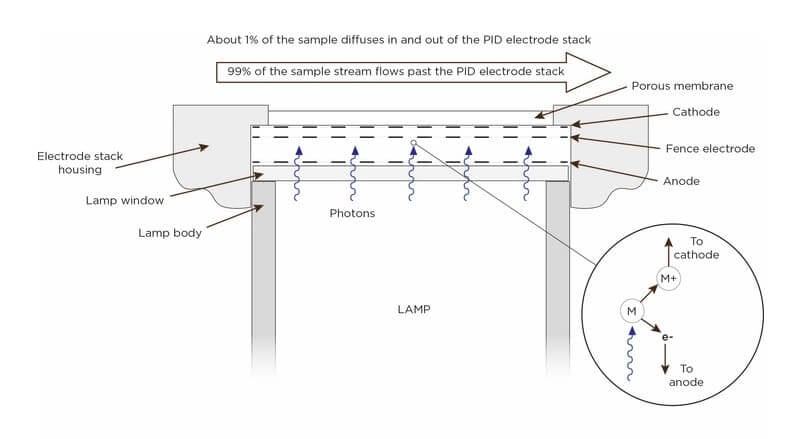
Above diagram: Inside the ION Science MiniPID sensor
There are several good reasons to use a PID for arson investigation:-
- PIDs are portable and battery powered making them ideal for field applications
- PIDs are a quick, simple to use and accurate method for the detection of accelerants at a fire scene
- PIDs are very sensitive to commonly found accelerants and will detect hundreds of gasses and vapours
- PIDs are non-destructive and will not affect the air sample which can be captured for further lab analysis
- PIDs reduce the quantity and cost of lab samples required to reach a conclusion as to the cause of the fire

Occupational exposure limits for benzene
Occupational exposure limits for benzene – EU Directive 2017/164/EU5 has introduced indicative occupational exposure limit values (IOELV).
These are health-based, non-binding values, derived from the most recent scientific data available and availability of measurement techniques. For any chemical agent for which an IOELV has been set at EU level, member States are required to establish a national occupational exposure limit (OEL) value. They are required to take into account the EU limit value, determining the nature of the national limit value in accordance with national legislation and current practice.
Member States are required to bring into force the laws, regulations and administrative provisions necessary to comply with this Directive by 21 August 2018 at the latest. IOELVs are established in relation to an 8 hour, time-weighted average (TWA) and, for certain chemical agents, to shorter reference periods, in general 15 minutes time-weighted average also known as short-term exposure limit values (STEL) to take account of the e ects arising from short-term exposure.
In the UK, the Health and Safety Executive (HSE) already publish OELs for a plethora of chemicals, including benzene, in a document known as EH406 Workplace Exposure Limits (WEL). They refer to a WEL value which means the same thing as an OEL.
The EU-wide 8 hour TWA for benzene is currently set at 1 part per million (ppm), equivalent to a concentration of 3.25mg/m3. However, the ECHA review shows that some member states have a significantly lower OEL value which probably indicates the ‘direction of travel’ for the OEL given that the World Health Organisation (WHO) says there is no safe level of exposure. It is also important to note the EU does not recommend an EU-wide benzene STEL value.
By contrast, legislation in the USA exists in the form of Federal Regulation 29 CFR part 19109 and while the legislative framework is less complex than the EU, the limit values vary according to dierent ‘agencies’ plus they all state a value for the STEL.
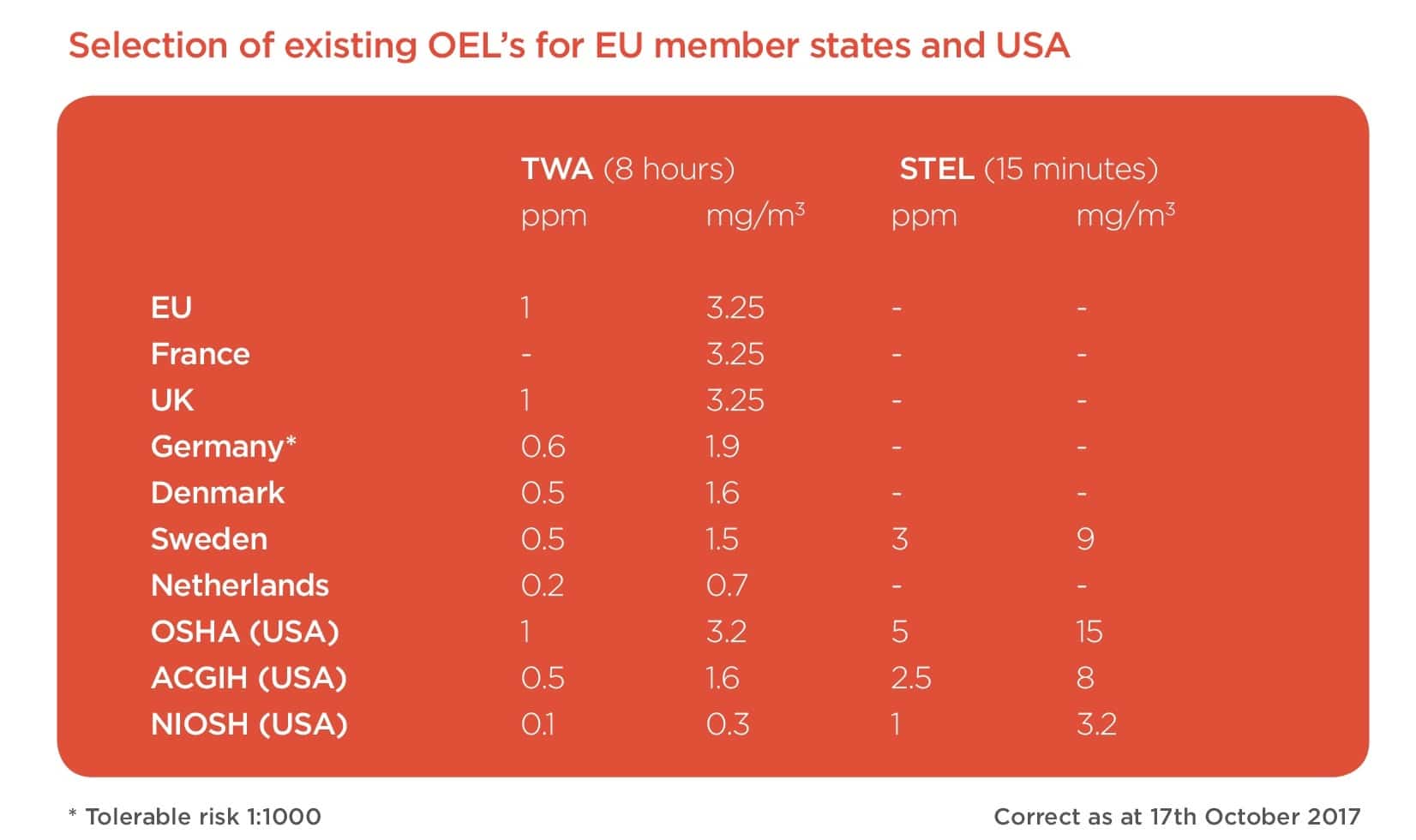
The table shows the existing OELs indicated as an 8-hour TWA and 15-minute STEL (where stated) for selected EU member states and USA.