
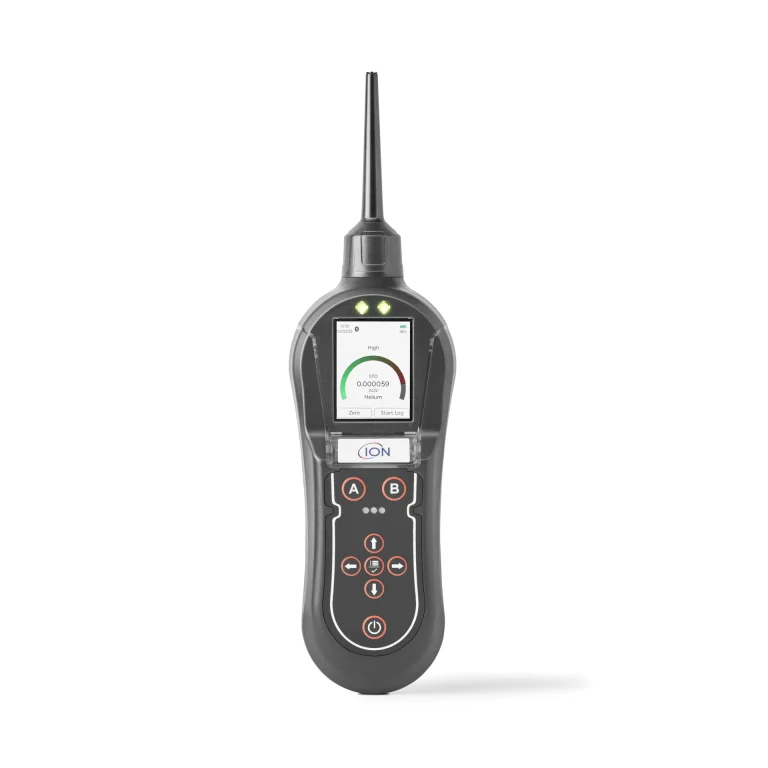
Panther Portable Gas Leak Detector
A handheld gas leak detector for locating leaks in equipment, pipework and systems during maintenance and leak investigations.
View product: Panther Portable Gas Leak DetectorHelium (He) is an inert, colourless and odourless gas widely used as a tracer gas for precision leak detection. Its small atomic size, chemical stability and low natural concentration in the atmosphere make helium ideal for locating even the smallest leaks across a wide range of industrial applications.
Helium leak detection is commonly used during manufacturing, quality control, maintenance and research to verify the integrity of components, systems and sealed equipment. From vacuum systems and refrigeration equipment to automotive components and aerospace applications, accurate helium leak detection helps ensure performance, reliability and product quality.

| Property | Value |
| Chemical Formula | He |
| CAS Number | 7440-59-7 |
| Molecular Weight | 4.00 g/mol |
| Appearance | Colourless gas |
| Odour | Odourless |
| Flammability | Non-flammable |
| Relative Density | Lighter than air |
| Common Detection Technologies | Microthermal Conductivity, Mass Spectrometry |
Helium is a naturally occurring noble gas that is chemically inert and non-reactive. Thanks to its exceptionally small atomic size, helium can escape through extremely small openings, making it one of the most effective tracer gases for leak detection.
Rather than monitoring helium as a hazardous gas, helium leak detection is used to identify leaks in sealed systems, verify product integrity and support quality assurance processes across many industries.

| Manufacturing & Industrial Processing | Research & Laboratory | Automotive |
|---|---|---|
| Verify the integrity of components, assemblies and sealed products during production and quality control. | Verify vacuum systems, scientific equipment and experimental apparatus where precision leak detection is essential. | Test fuel systems, air conditioning components, batteries and other sealed assemblies during manufacture. |
| Aerospace | Medical Devices | Refrigeration & HVAC |
|---|---|---|
| Ensure the integrity of fuel systems, hydraulic components and critical aerospace equipment. | Leak test medical equipment and sealed components to maintain product quality and reliability. | Locate refrigerant leaks and verify the performance of sealed cooling systems. |
Helium’s small atomic size enables the detection of leaks that may be difficult to identify using conventional methods.
Leak testing helps verify manufacturing quality and ensures components meet performance specifications before entering service.
Detecting and locating helium leaks early allows maintenance teams to target the affected component, reducing troubleshooting time and avoiding unnecessary repairs or replacement. Early intervention can also minimise product failures, unplanned downtime and disruption to operations.
Routine helium leak detection helps maintain the integrity and performance of critical systems throughout manufacturing, installation and service. It supports reliable operation across industrial, scientific, vacuum, refrigeration, automotive and aerospace applications.
Helium is used as a tracer gas during leak testing. The gas is introduced into a sealed system, and a helium leak detector is then used to identify and locate any escaping gas with exceptional sensitivity.
Portable helium leak detectors enable engineers to quickly pinpoint leaks during production, maintenance and inspection, providing a fast and reliable method for verifying system integrity.
Helium’s small atomic size, chemical stability and low background concentration make it an excellent tracer gas for identifying extremely small leaks.
Helium leak detection is widely used in manufacturing, automotive, aerospace, refrigeration, medical device production, research and laboratory applications.
Helium is introduced into or around the component being tested. A helium leak detector is then used to inspect likely leak points, such as seals, joints, valves, welds and connections.
If helium escapes through a defect, the detector responds to the gas and helps the operator locate the source of the leak. The precise test method depends on the component, test pressure and required leak-rate sensitivity.
Helium is non-toxic, non-flammable and chemically inert. However, a significant release can displace oxygen and create an asphyxiation hazard, particularly in an enclosed or poorly ventilated space.
Helium cylinders also contain gas under pressure, while liquid helium presents additional cryogenic hazards. Appropriate storage, handling, ventilation and risk-control procedures should therefore be followed.
Helium offers excellent sensitivity, is chemically inert, does not react with most materials and can detect extremely small leaks that may otherwise go unnoticed.
Helium is commonly used to test vacuum systems, refrigeration equipment, automotive components, aerospace systems, medical devices and sealed industrial assemblies.
Whether you’re carrying out quality control testing, locating leaks or verifying the integrity of sealed systems, our specialists can help you identify the most suitable helium leak detection solution for your application.
Get in touch with the ION Science team to discuss your requirements, arrange a product demonstration or speak to one of our gas detection experts.
