

12 Facts about Benzene
See 12 facts about Benzene below.
- Benzene is a chemical that is a colourless or light yellow liquid at room temperature.
- Benzene evaporates into the air very quickly. Its vapour is heavier than air and may sink into low-lying areas.
- Benzene is the simplest aromatic hydrocarbon and distinguished as the first aromatic hydrocarbons with the nature of its bonding first established in the 19th century.
- Benzene is widely used in the United States. It ranks in the top 20 chemicals for production volume.
- Some industries use benzene to make other chemicals that are used to make plastics, resins, and nylon and synthetic fibers. Benzene is also used to make some types of lubricants, rubbers, dyes, detergents, drugs, and pesticides.
- It occurs naturally in crude oil, natural gas and some ground waters.
- It belongs to the BTEX family (Benzene, Toluene, Ethylbenzene, Xylene) of so called aromatics because of their sweet, pleasant smell.
- It is found in ambient air as a result of burning fuels, such as coal, petrol and wood and is common in unleaded fuel, where it is added as a substitute for lead, allowing smoother running.
- Workers might be exposed to benzene during certain jobs, for example, in:-
Oil refineries
Chemical and petrochemical plants
Coke works
Foundries
The storage, distribution and use of petrol or benzene itself - Most benzene exposure comes from the air from a number of sources, including forest fires, auto exhaust and gasoline from fueling stations. Benzene in cigarette smoke is a major source of exposure.
- From a long term (chronic) health perspective, the World Health Organisation (WHO) and International Agency for Research on Cancer (IARC) classify benzene as a group one carcinogen.
- Prolonged exposure to high concentrations of benzene causes leukaemia and impacts red and white blood cells.
Benzene exposure
Benzene evaporates easily and most people can detect its distinctive smell at concentrations between 2.5 and 5 parts per million (ppm) in air.
As well as inhalation, benzene can be absorbed into the body through the skin or by swallowing material containing it. The effects on worker’s health depends upon how much benzene they are exposed to and for how long. The immediate effects of a single exposure to a high concentration (hundreds of ppm) include headache, tiredness, nausea, dizziness, and even unconsciousness, if the exposure is very high (thousands of ppm) meaning an acute safety incident.
From a long term (chronic) health perspective, the World Health Organisation (WHO) and International Agency for Research on Cancer (IARC) classify benzene as a group one carcinogen. Prolonged exposure to high or low benzene causes leukaemia and impacts red and white blood cells. The WHO has not set a standard for ambient benzene concentrations, stating that there is no safe level of exposure but many countries use an annual average standard of 3.6g m-3 which is equivalent to 1 part per billion (ppb) or 0.001 ppm.
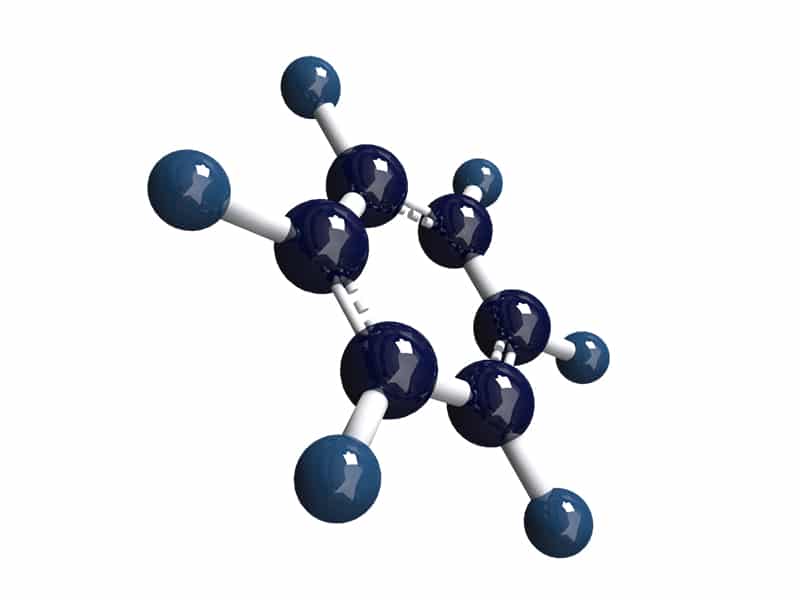
Definition
“The benzene ring is a basic component of many organic compounds, especially the aromatic hydrocarbons. In benzene itself, each carbon atom is also bonded to a hydrogen atom; in derivatives of benzene, one or more of the hydrogen atoms is replaced by other atoms or groups of atoms.” Dictionary.com
Benzene Ring
Thinking back to your school days and science, organic means the chemistry of carbon based compounds, which are substances that results from a combination of two or more different chemical elements. The atoms of the different elements are held together by chemical bonds that are difficult to break. These bonds form as a result of the sharing or exchange of electrons among the atoms.
Some volatile organic compounds (VOCs) are hydrocarbons but not all hydrocarbons are VOCs. The latter have a significant vapour pressure at normal ambient temperature which means they evaporate (volatilise) at low temperatures so they can easily enter the body through normal breathing.
Benzene, also known as benzol, is one such common VOC, identified by its unique numerical CAS2 number 71-42-2. It is also a hydrocarbon as you can see from the chemical formula of Benzene which is C6H6, represented diagrammatically as a ring, commonly know as the Benzene Ring (see opposite).
It belongs to the BTEX family (Benzene, Toluene, Ethylbenzene, Xylene) of so called aromatics because of their sweet, pleasant smell.
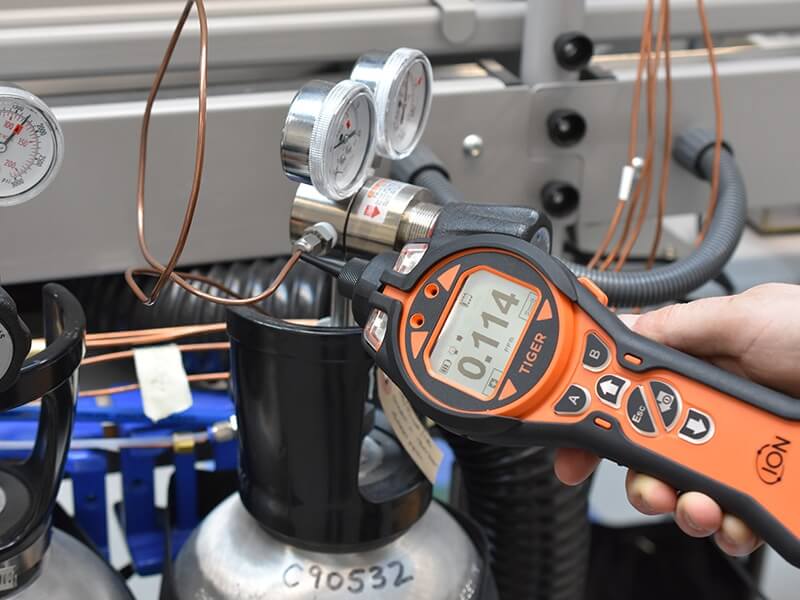
Introduction – calibrate gas detection equipment!
ATEX, IEC, British HSE, and US OSHA standards all call for the bump test and calibration of any portable instrument used for worker health and safety protection in a potentially hazardous environment. In order to ensure safety it is necessary not only for the gas meter to read accurately but also to have functional alarms that alert the worker to a hazardous condition. Initial calibration upon receiving the instrument is necessary and, because most sensors can suffer decreased response over time, recalibration will be required.
This article helps the user define appropriate time intervals between calibrations for their instrument. Although regulatory standards were written primarily for 4-gas confined space entry meters that have electrochemical sensors and pellistor-type combustible gas (LEL) sensors, this article is intended to include any ION Science instrument used for industrial hygiene, including also PIDs, infrared sensors, and fixed instruments.
Sensor Sensitivity Degradation
Many environmental conditions may degrade sensor response, including the following. LEL sensors are inhibited or poisoned by silicon compounds (some lubricants), sulfur compounds (e.g., H2S), lead (Pb) compounds, acids, and compounds that generate acids on combustion, like chlorinated hydrocarbons. Electrochemical sensors are affected by high levels of organic vapors and by corrosive gases. Ammonia, chlorine, and chlorine dioxide sensors lose response upon overexposure to NH3. PID lamps can lose output by a) simple aging, b) by becoming coated when exposed to excessive dust, high-boiling compounds, phosphine, organic amines or silazanes, or c) by contact with liquid water. And any sensor will lose response if sample gas does not adequately reach it because of leaks in the sample train or plugging of inlet dust filters. Thus, although most instrument will hold calibration for several days to several weeks, it is a good idea to check their accuracy regularly.
Calibration Frequency
The ISEA (International Safety Equipment Association) and ATEX recommend the following general procedure:
1a) A daily “Bump Test” before the instrument is put into use. Calibrate gas detection equipment just long enough to make the sensor(s) alarm, to ensure that the gas is getting to the sensor and that both the sensor and alarm are working. The gas does not need to be of a well-defined concentration and could be as simple as a permanent marker.
or
1b) A daily Calibration Check before the instrument is put into use. Calibrate gas detection equipment using calibration gas to see if the sensor responds within predefined error limits, typically within 10-20% of the expected value, as set by manufacturer’s recommendation or user’s company policy.
In critical cases where a permit to work is given as a result of a gas test, ATEX recommends that a bump test or calibration check also be conducted at the end of the day’s use to ensure that the instrument was functioning properly throughout the entire monitoring period.
2) Full Calibration if either the bump test or calibration check fail. A Full Calibration should also be conducted at regular intervals as recommended by the manufacturer, user’s company policy, or regulatory agency.
During initial use in the target environment calibration should be checked frequently. The time period should cover all expected environments the instrument will be subjected to. If the instrument maintains calibration over this time, the interval between checks can be extended. In this way, one can define the most suitable calibration frequency for a particular site or application.
In addition, the above test procedure should be conducted if any special circumstances occur that might affect sensor function, including, but not limited to:
- Frequent exposure to high or low temperatures, pressures, and humidity, to high particulate levels, or immersion in a liquid.
- Exposure to high (over range) concentrations of target or similar chemicals.
- Frequent exposure to sensor inhibitors and poisons, as described above.
- Exposure to harsh physical vibrations or shock.
- Upon transferring custody of the instrument to another person.