

ION Science wins Queen’s Award for Enterprise: Innovation for MiniPID Sensors
ION Science is delighted to announce it has won the prestigious Queen’s Award for Enterprise in the category of Innovation, for its pioneering MiniPID sensors. The award is the highest recognition of business excellence across Britain and endorses the commercial success in respect to the innovative technology. ION Science’s industry-leading PID (photoionisation detection) technology, offers unparalleled VOC detection.
The achievement of the Queen’s Award for Innovation reaffirms the quality, reliability and success of the MiniPID sensor. And just how dedicated ION Science is to developing and producing new technologies. Prior to the development of the MiniPID sensor range, VOC sensors often suffered from short operational life, unreliable technology, and failed in the face of challenging environmental conditions.
The MiniPID sensor addresses all these issues and more, highlighting why it is the market leader in quality and standards for all VOC sensors. Able to withstand relative humidity up to 99% (non-condensing), temperatures of -40 to +65 °C, and with an anti-contamination design, the MiniPID range offers 10,000 hours of reliable detection, ideal for long-term monitoring. Sensitivity for VOC measurement can be conducted in ppm (parts per million) or ppb (parts per billion), over a wide range or across a small area. ION Science’s sensors can be used to detect up to 950 different compounds, many of which pose a serious threat to human health and life if people are exposed.
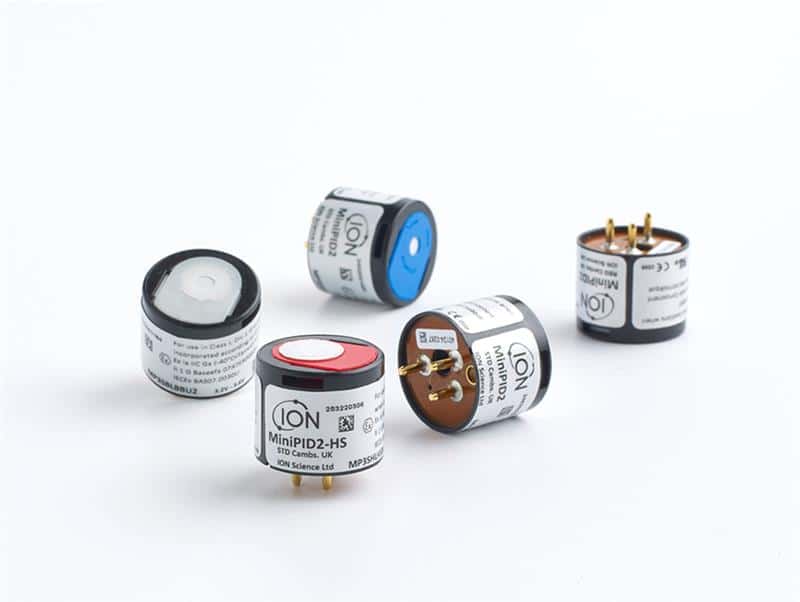
Duncan Johns, Managing Director of ION Science, said of the win: “It’s wonderful to see the hard work of all the staff here at ION Science recognised with the success of the Queen’s Award. As an organisation we are always striving to achieve the next level of innovation in technology, which is exactly represented by the MiniPID sensor range. We’re looking forward to the future of ION Science and the next steps with our award-winning sensors.”
Dr Peter Morris, head of the Sensors Product Business Unit at ION Science, also spoke of the MiniPID: “Achieving this outstanding level of recognition for the MiniPID sensor is a fantastic result for the Sensors team. Many of us have worked at ION Science for decades and seen the development of the MiniPID since its inception in 2007. Being able to have the affirmation of the MiniPID sensor as an ‘Innovation’ by the Queen’s Award for Enterprise is a great highlight and we’re very proud to receive it.”
Across the globe today, MiniPID sensors can be found in many applications, including oil rigs, gas refineries, pharmaceutical manufacturing plants, semiconductor factories, laboratories, nuclear facilities, air quality monitoring and more, protecting the health and safety of workers, public and the environment.
MiniPID sensors represent a monumental step forward in protecting staff, but also in ensuring product quality and keeping workplaces as healthy as possible. The advanced VOC detection capabilities mean that no matter what application, environment, or compounds, MiniPID sensors exceed the customer need and delivers high quality, reliable results.

ION Science’s range of MiniPID sensors are now available to buy directly from the award winning manufacturer – contact them today to find out more: https://ionscience.com/en/sensors-and-components/oem-sensors/
For press enquiries please contact: Hannah Albone hannah.albone@cogent.co.uk or 07483047567, alternatively contact David Leatham David.leatham@cogent.co.uk or 07483 071 833.
To find out more about ION Science and our award winning innovative MiniPID technology!
Please complete the form below and a member of our team will contact you shortly.

How fixed gas detection solutions are supporting World Day for Safety and Health at Work
The International Labour Organisation (ILO) marks its World Day for Safety and Health at Work on 28th April 2022. The spotlight on providing safe and healthy places to work has become more prominent in recent times, particularly as working practices emerged and evolved rapidly as part of the COVID-19 pandemic.
World Day for Safety and Health at Work is designed as an initiative, aimed at encouraging people and businesses to leverage an effective occupational health and safety (OHS) system to reduce risk and improve working conditions for all. As a result ILO is exploring the topic of participation and social dialogue in creating a positive safety and health culture.
ION Science is committed to protecting lives and preserving the environment with technologically advanced gas detection instrumentation. As a leading OEM in the development, manufacture, and supply of PID (photoionisation detection) volatile organic compound (VOC) gas detectors. ION Science has been working to keep workers and environments safe for over 30 years. A key part of ION Science’s portfolio is fixed gas detectors, which can play a vital role in a organisations occupational health and safety approach.
In industrial facilities where hazardous substances are part of the daily routine, fixed gas detectors are used to protect employees, for site-safety (assets) and the environment. Their purpose is to control gas-related risks and provide continuous monitoring for the prevention of explosive gas leaks or overexposure to toxic gases. The right and reliable fixed gas detection system can prevent and limit the impact of a potential gas leak.
Fixed detectors can be classified and approved for use in ATEX-zoned hazardous areas or what are deemed safe areas. That choice will usually be based on a gas hazard survey and/or a DSEAR report depending on the site and application. Once a working area has been identified as hazardous it must be classified into a zone based upon the frequency and persistency of the potentially explosive atmosphere. This will help to determine the controls needed on potential sources of ignition that may be present in the area:
- Zone 1 hazardous areas are classified as a working area where the presence of explosive gas is likely to occur during normal working conditions.
- Zone 2 hazardous areas are classified as working areas in which explosive gas is not likely to occur during normal operation and if it does it would not be for an extended period of time.
ION Science’s two main fixed gas detectors are the Falco and Titan. The Falco fixed gas detector is available as either a pumped or diffusive model. The Falco is intrinsically safe and ATEX certified making it approved for use in ATEX-zoned hazardous areas. It does not require a hot work permit, and only requires annual maintenance. Falco gas detectors are designed with Typhoon technology, making it able to withstand exceptionally harsh environments, including 0-100% relative humidity and condensing humidity, and temperatures from -40 to +50 °C without any compromise in performance. When you have the right gas detection system in place, your workers and site stay safe, and work continues smoothly.
Titan is a benzene-specific fixed gas detector, making it ideal for use in petrochemical applications. Benzene poses a serious health risk, even at low concentrations, so monitoring is essential for safe working environments. ION Science’s Titan detector is the only continuous benzene-specific fixed gas detector on the market, offering end users a unique ability to monitor benzene concentrations 24/7 to ensure any risk can be mitigated. With fast and accurate monitoring down to 0.1 ppm, the Titan is designed with worker health and safety in mind, alongside reliable, accurate benzene monitoring. It is also certified to ATEX, IECEx, UL and CSA standards for total reliability.
This World Day for Safety and Health, it is important to understand the role that technology can play in improving approaches to health and safety. With greater awareness, improved initiatives, better prevention tactics and a willingness to leverage effective occupational health and safety, the likelihood of improving working conditions for all is possible. ION Science is proud to offer fixed gas detectors which can aid in the detection and prevention of exposure to harmful VOCs and play a part in supporting worker health and safety around the world.
To find out more about World Day for Safety and Health at Work, please visit: https://www.ilo.org/global/topics/safety-and-health-at-work/events-training/events-meetings/world-day-safety-health-at-work/WCMS_836801/lang–en/index.htm
For press enquiries please contact: Hannah Albone hannah.albone@cogent.co.uk or 07483047567, alternatively contact David Leatham David.leatham@cogent.co.uk or 07483 071 833.
To find out more about how ION Science can support World Day for Safety & Health at Work with fixed gas detection solutions.
Please complete the form below and a member of our team will contact you shortly.

What is a Part Per Million (PPM)?
Measuring Acetone to Hydrogen sulphide, Benzene to Xylene, if you are measuring harmful gases, you are likely to measure them using PPM units. Parts Per Million is self-explanatory, it’s simply the number of gas molecules in a million but what does PPM look like?
This simple video offers a clear graphical representation of Part Per Million followed by Part Per Billion!
YouTube video playerNeed to know more about harmful gases?
Gas fact sheets are available to download for many harmful gases. They not only contain background information like the chemical’s history, they include where the gas is used and harmful effects.

As leaders in gas analysis and detection of volatile organic compounds, ION Science are at the forefront of the latest news and developments. Terminology in the field is often changing or alters between countries and legislative bodies. No definition is more important to the industry than that of the VOC.
Typically, we understand the term VOC to mean volatile organic compound. This refers to any organic compound that can be found as a gas in the atmosphere. However, not all VOCs are harmful or dangerous. Some can be in certain concentrations or environments, but regardless of the risk, monitoring them is essential to manage exposure. Particularly for the industries that ION Science supports, having essential gas detection and analysis capabilities is critical, therefore having universally understood terminology is essential.
VOC is a term that can be applied to any volatile organic compound, generally it is more commonly used for health and safety and indoor air quality. Although, the general term used for outdoor air quality is non methane volatile organic compound, or NMVOC.
The reason for specifying whether the VOC is methane or non-methane has become more important in recent years, as the rules around how certain VOCs and other gases are monitored has shifted.

Definition of an NMVOC
The technical definition of an NMVOC, as given in the official guidelines from the European Monitoring and Evaluation Programme (EMEP) is as follows:
“NMVOCs comprise all organic compounds except methane which at 293.15 K show a vapour pressure of at least 0.01 kPa (i.e. 10 Pa) or which show a comparable volatility under the given application conditions”
The Air Quality Expert Group (AQEG) define NMVOCs as:
“…a broad class of organic chemicals that are, in a small number of cases, directly harmful to health, but that more generally act as precursors to the formation of ozone and particulate matter (PM).”
The volatility of a compound is generally higher the lower its boiling point temperature, the volatility of organic compounds is therefore sometimes defined and classified by boiling points. Importantly this definition can differ by geography, for example, the European Union uses the boiling point, rather than its volatility in its definition.
Why is methane excluded?
Methane is a common emission resulting from many activities, such as road transport, manufacturing, and agriculture. However, methane is excluded from VOC monitoring in many cases, as it is relatively non-toxic and poses little harm to human health (although it does pose notable environmental concerns). By excluding methane from VOC analysis and detection by isolating non-methane volatile organic compounds, it is easier to understand the impact of NMVOCs on human health.
Methane is also typically present in high concentrations in atmospheric conditions. Although, PID instrumentation doesn’t detect methane, and environmental concentrations of methane don’t adversely affect PID readings. Methane concentrations are at 2ppm, whereas NMVOCs are much lower than this. Therefore, if the instrumentation detected Methane, it would mask the other elements. This is one of the reasons why PIDs are effective at measuring/detecting outdoor VOCs. When you are aiming to detect potentially trace amounts (parts per million or billion) of highly potent VOCs, being able to have analysis and detection that is not impacted by more common compounds is vital for accuracy and appropriate levels of safety and protection.
ION Science develop, manufacture, and supply gas detection instruments that can detect a range of VOCs and NMVOCs, depending on the requirements of the customer. To keep staff and the public safe in all environments, ION Science gas detection offers unrivalled capabilities and unbeatable accuracy. Discover more about the portable, personal, and fixed instruments today, or explore the range of industry leading PID sensors.
For press enquiries please contact: Hannah Albone hannah.albone@cogent.co.uk or 07483047567, alternatively contact David Leatham David.leatham@cogent.co.uk or on 07483 071 833.
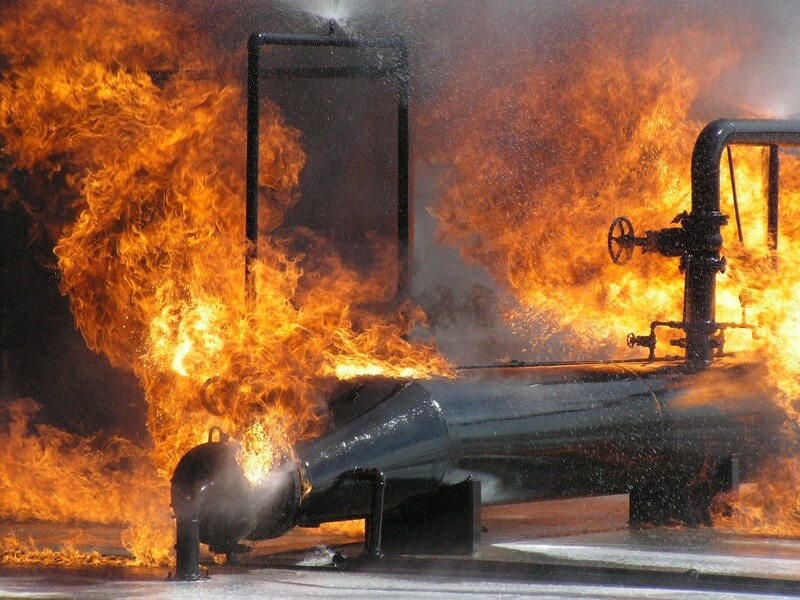
PID for Arson Investigation
One such tool for the detection of accelerants at fire scenes recommended by investigators3 is the photoionisation detector (PID) which has already proven to be an ideal solution for the detection of relatively low level VOCs for health & safety and environmental applications.
These devices are battery powered and portable and can be deployed rapidly and safely to test areas between floorboards and under carpets where residual traces of accelerant may remain.
Where positive indications of accelerant residue are discovered, grab samples can be taken and carefully stored for subsequent analysis using headspace sampling and gas chromatography (GC). During headspace sampling, debris is collected in a part-filled, sealed jar and allowed to stabilise as debris is collected in a part-filled, sealed jar and allowed to stabilise at room temperature.
Any VOCs present will volatise (evaporate) and concentrate in the ‘headspace’ leading to a positive, reading on the PID. PIDs are ‘broadband’ in nature whereas GCs can speciate exact chemical makeup, therefore, only samples which incite high or significant PID readings need to be sent for more detailed analysis, saving time and money.
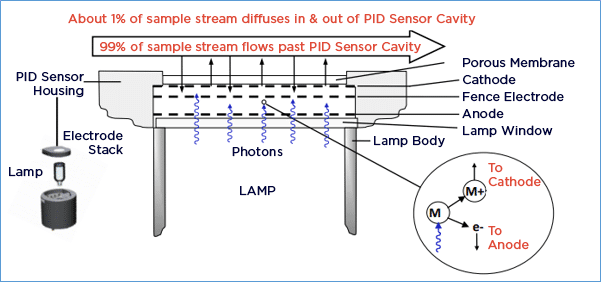
Figure 2 is a schematic of a proprietary PID sensor system. A UV lamp generates high-energy photons, which pass through the lamp window and into the sensor chamber. Ambient air is pumped over the sensor and about 1% of it diffuses through a porous membrane filter into the other side of the sensor chamber. The inset on the lower right of figure 2 shows what happens on a molecular level. When a photon with enough energy strikes a molecule M, an electron (e-) is ejected. M+ ion travels to the cathode and the electron travels to the anode, resulting in a current proportional to the VOC concentration. The electrical current is amplified and displayed as a part per million (ppm) or part per billion (ppb) concentration.
Not all molecules can be ionised. Conveniently, the major components of clean air i.e. nitrogen, oxygen, carbon dioxide, argon, etc., do not cause a response, but most accelerants do give a broadband response.
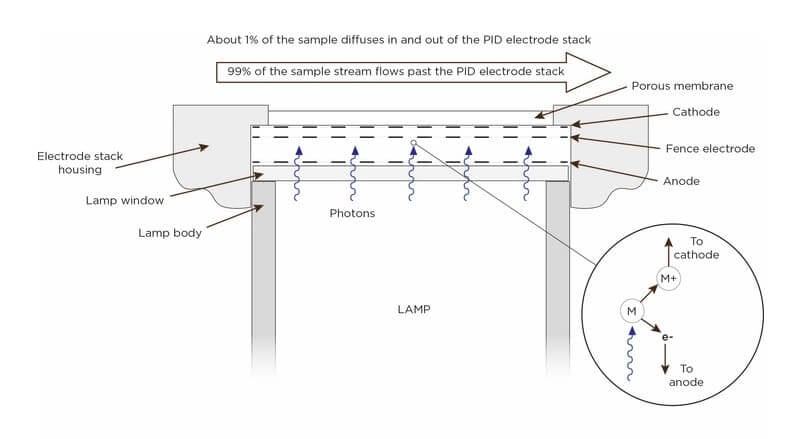
Above diagram: Inside the ION Science MiniPID sensor
There are several good reasons to use a PID for arson investigation:-
- PIDs are portable and battery powered making them ideal for field applications
- PIDs are a quick, simple to use and accurate method for the detection of accelerants at a fire scene
- PIDs are very sensitive to commonly found accelerants and will detect hundreds of gasses and vapours
- PIDs are non-destructive and will not affect the air sample which can be captured for further lab analysis
- PIDs reduce the quantity and cost of lab samples required to reach a conclusion as to the cause of the fire
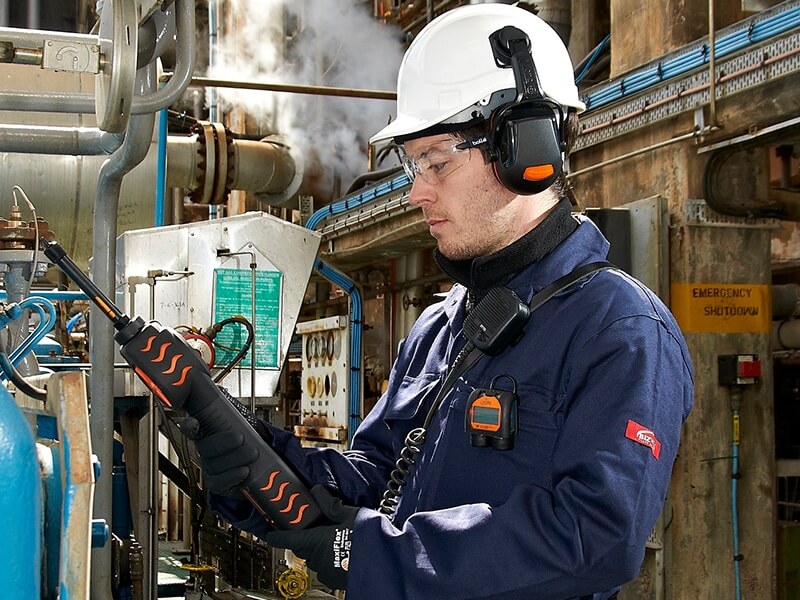
The photoionisation detector (PID) has proven to be an ideal solution to monitor benzene within the environment. But there are several considerations that must be borne in mind when choosing an instrument.
PID theory of operation
Figure 1 is a schematic of a typical PID sensor system. A UV lamp generates high- energy photons, which pass through the lamp window and a mesh electrode into the sensor chamber. Sample gas is pumped over the sensor and about 1% of it passes through a porous membrane into the other side of the sensor chamber. The inset on the ‘lower right’ of figure 1 shows what happens on a molecular level. When a photon with enough energy strikes a molecule M, an electron (e-) is ejected. M+ ion travels to the cathode and the electron travels to the anode, resulting in a current proportional to the gas concentration. The electrical current is amplified and displayed as a ppm (or part per billion (ppb)) concentration. Not all molecules can be ionized, thus, the major components of clean air, i.e., nitrogen, oxygen, carbon dioxide, argon, etc., do not cause a response, but most VOCs do give a response.
Which lamp do I need?
Typically, three lamps are available with maximum photon energies, measured in electron- volts (eV), of 10.0 eV, 10.6 eV, and 11.7 eV. Figure 2 illustrates that a lamp can only detect those compounds with ionization energies (IE) equal to or below that of the lamp. Thus, a 10.6 eV lamp can measure Methyl Bromide with an IE of 10.5 eV and all compounds with a lower IE, but cannot detect methanol or compounds with a higher IE.
The choice of lamp therefore depends on the application. When only one compound is present, one can use any lamp with enough energy, often the standard 10.6 eV lamp which has a lower cost point and has a long working life of up to a few years. Conversely the 11.7 eV lamp has a short life of only a few months.
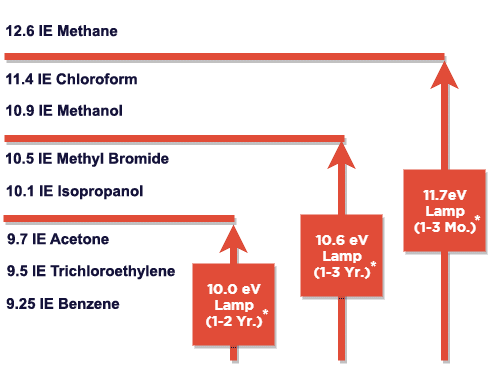
Benzene has a low IE value as shown in Figure 2 and it is often present in a ‘cocktail’ of other chemicals including aromatics and aliphatic. Using a proprietary 10.0 eV lamp means that only the aromatics are detected (amongst other gasses that may be present) and should the total aromatic compounds (TACs) be above the regulatory limit, a benzene pre- filter tube can be used to provide a more accurate reading to monitor benzene.
Introduction – calibrate gas detection equipment!
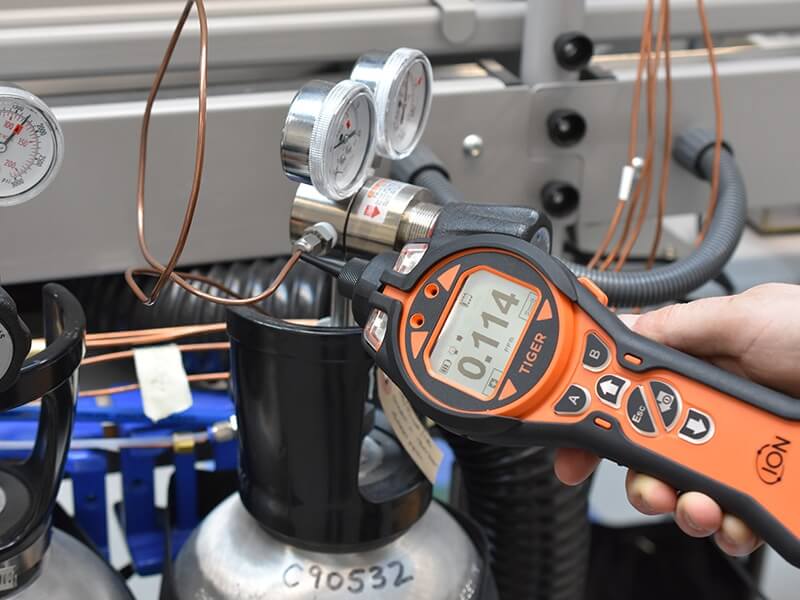
ATEX, IEC, British HSE, and US OSHA standards all call for the bump test and calibration of any portable instrument used for worker health and safety protection in a potentially hazardous environment. In order to ensure safety it is necessary not only for the gas meter to read accurately but also to have functional alarms that alert the worker to a hazardous condition. Initial calibration upon receiving the instrument is necessary and, because most sensors can suffer decreased response over time, recalibration will be required.
This article helps the user define appropriate time intervals between calibrations for their instrument. Although regulatory standards were written primarily for 4-gas confined space entry meters that have electrochemical sensors and pellistor-type combustible gas (LEL) sensors, this article is intended to include any ION Science instrument used for industrial hygiene, including also PIDs, infrared sensors, and fixed instruments.
Sensor Sensitivity Degradation
Many environmental conditions may degrade sensor response, including the following. LEL sensors are inhibited or poisoned by silicon compounds (some lubricants), sulfur compounds (e.g., H2S), lead (Pb) compounds, acids, and compounds that generate acids on combustion, like chlorinated hydrocarbons. Electrochemical sensors are affected by high levels of organic vapors and by corrosive gases. Ammonia, chlorine, and chlorine dioxide sensors lose response upon overexposure to NH3. PID lamps can lose output by a) simple aging, b) by becoming coated when exposed to excessive dust, high-boiling compounds, phosphine, organic amines or silazanes, or c) by contact with liquid water. And any sensor will lose response if sample gas does not adequately reach it because of leaks in the sample train or plugging of inlet dust filters. Thus, although most instrument will hold calibration for several days to several weeks, it is a good idea to check their accuracy regularly.
Calibration Frequency
The ISEA (International Safety Equipment Association) and ATEX recommend the following general procedure:
1a) A daily “Bump Test” before the instrument is put into use. Calibrate gas detection equipment just long enough to make the sensor(s) alarm, to ensure that the gas is getting to the sensor and that both the sensor and alarm are working. The gas does not need to be of a well-defined concentration and could be as simple as a permanent marker.
or
1b) A daily Calibration Check before the instrument is put into use. Calibrate gas detection equipment using calibration gas to see if the sensor responds within predefined error limits, typically within 10-20% of the expected value, as set by manufacturer’s recommendation or user’s company policy.
In critical cases where a permit to work is given as a result of a gas test, ATEX recommends that a bump test or calibration check also be conducted at the end of the day’s use to ensure that the instrument was functioning properly throughout the entire monitoring period.
2) Full Calibration if either the bump test or calibration check fail. A Full Calibration should also be conducted at regular intervals as recommended by the manufacturer, user’s company policy, or regulatory agency.
During initial use in the target environment calibration should be checked frequently. The time period should cover all expected environments the instrument will be subjected to. If the instrument maintains calibration over this time, the interval between checks can be extended. In this way, one can define the most suitable calibration frequency for a particular site or application.
In addition, the above test procedure should be conducted if any special circumstances occur that might affect sensor function, including, but not limited to:
- Frequent exposure to high or low temperatures, pressures, and humidity, to high particulate levels, or immersion in a liquid.
- Exposure to high (over range) concentrations of target or similar chemicals.
- Frequent exposure to sensor inhibitors and poisons, as described above.
- Exposure to harsh physical vibrations or shock.
- Upon transferring custody of the instrument to another person.

Occupational exposure limits for benzene
Occupational exposure limits for benzene – EU Directive 2017/164/EU5 has introduced indicative occupational exposure limit values (IOELV).
These are health-based, non-binding values, derived from the most recent scientific data available and availability of measurement techniques. For any chemical agent for which an IOELV has been set at EU level, member States are required to establish a national occupational exposure limit (OEL) value. They are required to take into account the EU limit value, determining the nature of the national limit value in accordance with national legislation and current practice.
Member States are required to bring into force the laws, regulations and administrative provisions necessary to comply with this Directive by 21 August 2018 at the latest. IOELVs are established in relation to an 8 hour, time-weighted average (TWA) and, for certain chemical agents, to shorter reference periods, in general 15 minutes time-weighted average also known as short-term exposure limit values (STEL) to take account of the e ects arising from short-term exposure.
In the UK, the Health and Safety Executive (HSE) already publish OELs for a plethora of chemicals, including benzene, in a document known as EH406 Workplace Exposure Limits (WEL). They refer to a WEL value which means the same thing as an OEL.
The EU-wide 8 hour TWA for benzene is currently set at 1 part per million (ppm), equivalent to a concentration of 3.25mg/m3. However, the ECHA review shows that some member states have a significantly lower OEL value which probably indicates the ‘direction of travel’ for the OEL given that the World Health Organisation (WHO) says there is no safe level of exposure. It is also important to note the EU does not recommend an EU-wide benzene STEL value.
By contrast, legislation in the USA exists in the form of Federal Regulation 29 CFR part 19109 and while the legislative framework is less complex than the EU, the limit values vary according to dierent ‘agencies’ plus they all state a value for the STEL.
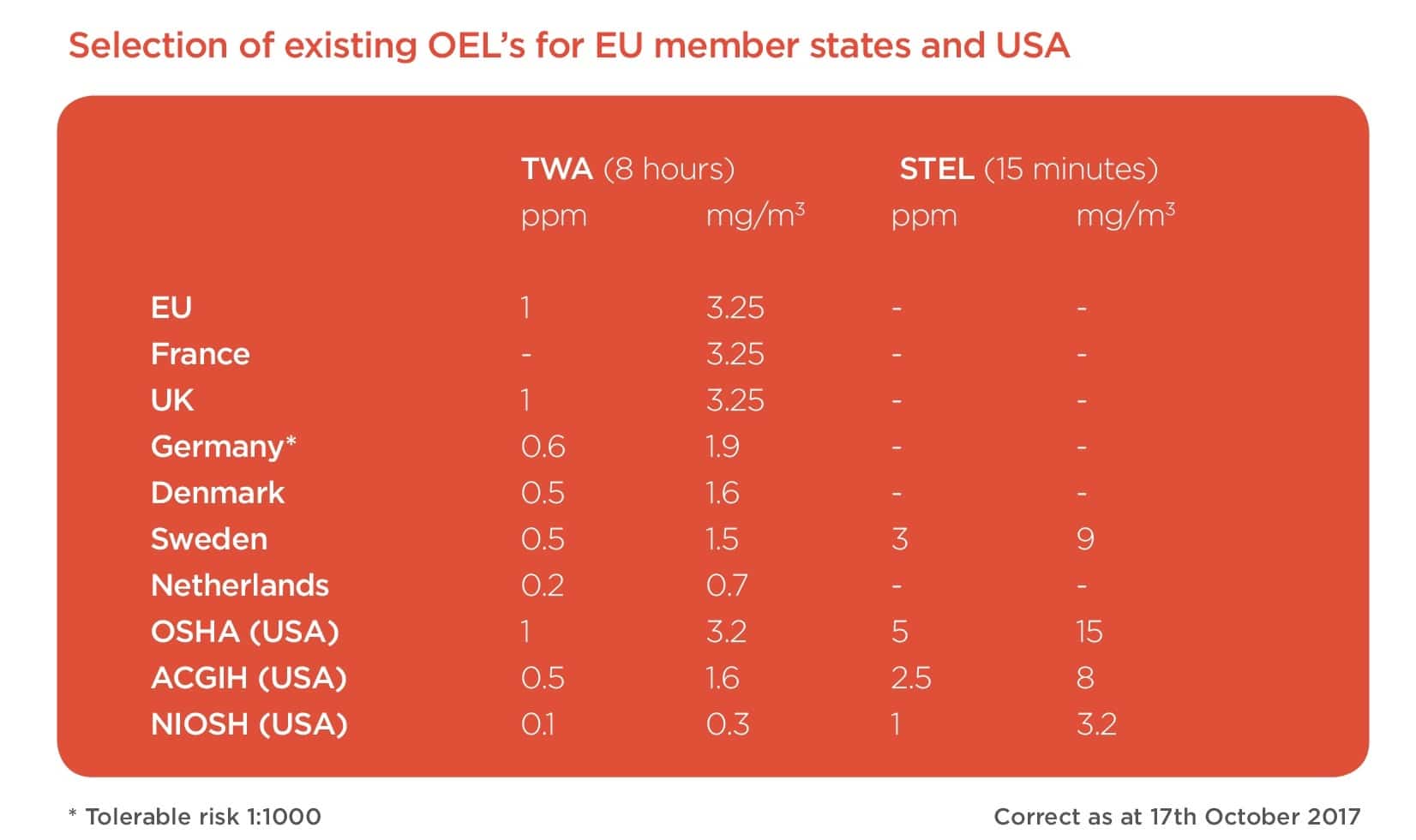
The table shows the existing OELs indicated as an 8-hour TWA and 15-minute STEL (where stated) for selected EU member states and USA.
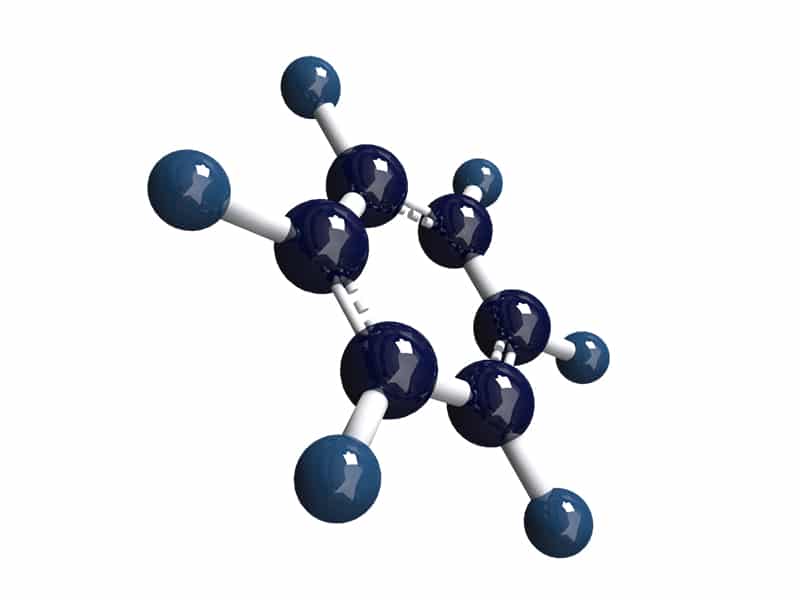
Definition
“The benzene ring is a basic component of many organic compounds, especially the aromatic hydrocarbons. In benzene itself, each carbon atom is also bonded to a hydrogen atom; in derivatives of benzene, one or more of the hydrogen atoms is replaced by other atoms or groups of atoms.” Dictionary.com
Benzene Ring
Thinking back to your school days and science, organic means the chemistry of carbon based compounds, which are substances that results from a combination of two or more different chemical elements. The atoms of the different elements are held together by chemical bonds that are difficult to break. These bonds form as a result of the sharing or exchange of electrons among the atoms.
Some volatile organic compounds (VOCs) are hydrocarbons but not all hydrocarbons are VOCs. The latter have a significant vapour pressure at normal ambient temperature which means they evaporate (volatilise) at low temperatures so they can easily enter the body through normal breathing.
Benzene, also known as benzol, is one such common VOC, identified by its unique numerical CAS2 number 71-42-2. It is also a hydrocarbon as you can see from the chemical formula of Benzene which is C6H6, represented diagrammatically as a ring, commonly know as the Benzene Ring (see opposite).
It belongs to the BTEX family (Benzene, Toluene, Ethylbenzene, Xylene) of so called aromatics because of their sweet, pleasant smell.

12 Facts about Benzene
See 12 facts about Benzene below.
- Benzene is a chemical that is a colourless or light yellow liquid at room temperature.
- Benzene evaporates into the air very quickly. Its vapour is heavier than air and may sink into low-lying areas.
- Benzene is the simplest aromatic hydrocarbon and distinguished as the first aromatic hydrocarbons with the nature of its bonding first established in the 19th century.
- Benzene is widely used in the United States. It ranks in the top 20 chemicals for production volume.
- Some industries use benzene to make other chemicals that are used to make plastics, resins, and nylon and synthetic fibers. Benzene is also used to make some types of lubricants, rubbers, dyes, detergents, drugs, and pesticides.
- It occurs naturally in crude oil, natural gas and some ground waters.
- It belongs to the BTEX family (Benzene, Toluene, Ethylbenzene, Xylene) of so called aromatics because of their sweet, pleasant smell.
- It is found in ambient air as a result of burning fuels, such as coal, petrol and wood and is common in unleaded fuel, where it is added as a substitute for lead, allowing smoother running.
- Workers might be exposed to benzene during certain jobs, for example, in:-
Oil refineries
Chemical and petrochemical plants
Coke works
Foundries
The storage, distribution and use of petrol or benzene itself - Most benzene exposure comes from the air from a number of sources, including forest fires, auto exhaust and gasoline from fueling stations. Benzene in cigarette smoke is a major source of exposure.
- From a long term (chronic) health perspective, the World Health Organisation (WHO) and International Agency for Research on Cancer (IARC) classify benzene as a group one carcinogen.
- Prolonged exposure to high concentrations of benzene causes leukaemia and impacts red and white blood cells.
Benzene exposure
Benzene evaporates easily and most people can detect its distinctive smell at concentrations between 2.5 and 5 parts per million (ppm) in air.
As well as inhalation, benzene can be absorbed into the body through the skin or by swallowing material containing it. The effects on worker’s health depends upon how much benzene they are exposed to and for how long. The immediate effects of a single exposure to a high concentration (hundreds of ppm) include headache, tiredness, nausea, dizziness, and even unconsciousness, if the exposure is very high (thousands of ppm) meaning an acute safety incident.
From a long term (chronic) health perspective, the World Health Organisation (WHO) and International Agency for Research on Cancer (IARC) classify benzene as a group one carcinogen. Prolonged exposure to high or low benzene causes leukaemia and impacts red and white blood cells. The WHO has not set a standard for ambient benzene concentrations, stating that there is no safe level of exposure but many countries use an annual average standard of 3.6g m-3 which is equivalent to 1 part per billion (ppb) or 0.001 ppm.