Leaded vs Lead-Free O2 Sensors: What You Need to Know
O₂ sensors have been a staple in gas detection for years, but with regulations tightening, more people are starting to ask the same question: should we still be using leaded sensors?
The answer isn’t black and white, but it is changing.
Leaded O₂ sensors have stuck around for a reason. They’re reliable, stable, and familiar to many users in the field. On the other side, lead-free O₂ sensors are becoming more common as manufacturers respond to environmental pressure and future regulation.
Explore what RoHS guidelines surrounded leaded sensors means for you.
RoHS Compliance
The Restriction of Hazardous Substances Directives 2002/95/EC & 2011/65/EU as amended by (EU)2015 / 863/EU (RoHS) limits the use of hazardous substances – in this case, lead – in electronic equipment in the EU and EU-aligned regions. For example, electronic equipment manufactured or sold in the UK must also comply with RoHS guidelines.
There is no confirmed timeline yet for when leaded sensors will be banned, but it is widely expected to happen soon, therefore the question is more about when it will come into force, not if it will happen at all. This has driven a requirement for original equipment manufacturers (OEMs) to explore lead-free O2 sensor options for their products or in some cases, means that manufacturers exclusively offer a lead-free O2 sensor.
Leaded O2 Sensors: Benefits and Limitations
Leaded O2 sensors have been used for many years and are well understood in the field.
Benefits:
✓ Proven, reliable performance
✓ Stable output over time
✓ Typically lower upfront cost
Drawbacks:
✗ Contains lead, which is a restricted substance under RoHS
✗ Rely on exemptions that may not remain in place long-term
✗ Less aligned with environmental protection efforts
Lead-Free O2 Sensors: Benefits and Limitations
Lead-free sensors have been developed to address environmental concerns and future regulatory changes.
Benefits:
✓ Do not contain hazardous lead
✓ Support long-term compliance planning
✓ Better aligned with environmental and sustainability goals
Drawbacks:
✗ Can come at a higher upfront cost
✗ May be newer to some users compared to traditional options
A Flexible Approach with ARA-X4
When it comes to O₂ sensor selection, the reality is that different organisations have different priorities. Cost, compliance, sustainability targets, and internal policies all play a role. That is why a one-size-fits-all approach does not always work.
ION Science’s ARA-X4 multi gas detector is designed to give you a choice. It supports both leaded and lead-free O₂ sensors, allowing you to select the option that best fits your current operation, without limiting future decisions.
This flexibility is particularly useful when you consider how different organisations approach purchasing:
- Smaller businesses or teams with tighter budgets may prioritise lower upfront cost and choose a leaded sensor
- Larger organisations, or those working towards environmental targets or certifications such as ISO 14001, may prefer a lead-free option to align with sustainability goals
- Some companies may choose a mixed approach across sites or projects depending on requirements
![[ARA-X4 Multi Gas Detector]](https://ionscience.com/wp-content/uploads/2025/03/ARA-X4-Pinpoint-1.png)
Rather than forcing a compromise, ARA-X4 allows you to make an informed decision based on what matters most to you.
ARA-X4 Sensor Options at a Glance
Gas detection is not one-size-fits-all, and your sensor setup should reflect how and where you are working. With ARA-X4, the focus is on flexibility and freedom of choice. You are not limited to a single configuration. Instead, you can select from a range of sensor options to suit your specific application, whether that is driven by cost, performance, environment, or internal standards.
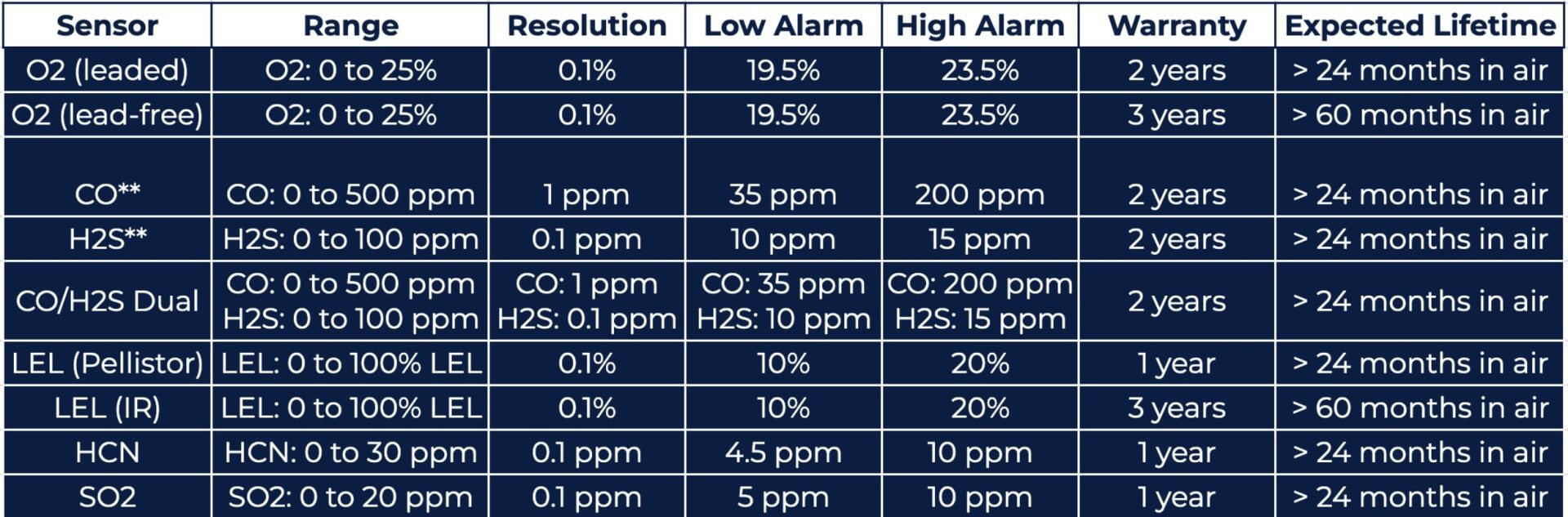
The table below is designed to make that decision easier. It sets out the key differences between each sensor type, including range, resolution, alarm levels, warranty, and expected lifetime, so you can make a clear and informed choice based on what matters most to you.
Supporting Informed Decision-Making
Having both options available is not just about flexibility, it is about giving users the information and control they need to make the right choice. Whether the priority is reducing cost, meeting internal sustainability goals, or preparing for future compliance changes, ARA-X4 supports that decision without adding complexity. It also means you are not locked into one approach. As regulations evolve or business priorities change, your equipment can adapt with you.
Looking for a gas detector that gives you flexibility now and in the future? Fill out the form below to learn more about ARA-X4 and your O₂ sensor options.





 United Kingdom


 USA
USA France
 India
India China
China Italy
Italy Germany